
 English
 Français
  Deutsch
 Italiano
 Turkish
 Greek
Greek Serbian
105 years since the death of Ismail bey Vlora




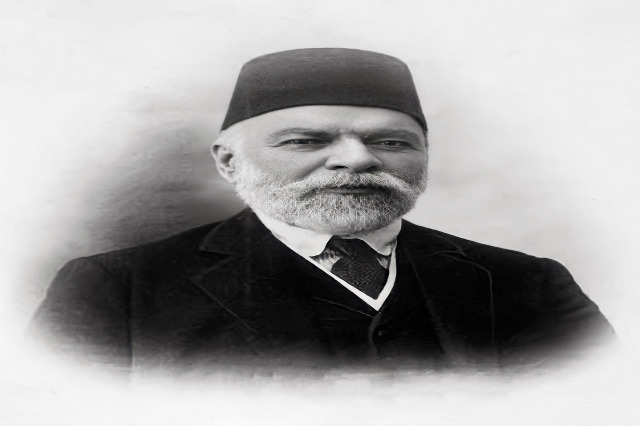
The National Historical Museum today commemorated the death of Ismail Qemali, a leader of the Albanian National Movement. He was born in Vlora on January 24, 1844, in one of the largest families in South Albania. After finishing primary school in his hometown, he continued his studies at the Turkish comprehensive school in Thessaloniki, where his family was interned. Later, he completed his education at the ‘Zosimea’ high school in Ioannina.
In 1860, he worked as a translator at the translation office of the High Gate. From 1862 to 1864, he served in the local administration in Ioannina and later moved to Tërhalle (Thessaly) before returning to Istanbul. He actively participated, alongside Jani Vreto, Hoxhe Tahsin, Kostandin Kristoforidhi, Pashko Vasa, and Sami Frashëri, in the first meeting for the assignment of the Albanian alphabet and the formation of an Albanian cultural society. Subsequently, Ismail Qemali held various high positions in the Turkish administration, such as Chief Secretary of the Ministry of Foreign Affairs in Istanbul, Mytesarif of Varna (Bulgaria), Governor of the Lower Danube (Tulxë-Bulgaria), and more.
In 1877, the High Gate accused him of opposing the politics of Sultan Abdyl Hamit II and supporting the liberal views of Mithat Pasha, a high official of the Empire and reformer. Following these accusations, the High Gate sentenced him to 7 years of exile in the cities of Kytahja, Eskishehir, and Bursa in Anatolia. Released in 1884, he was appointed as Mytesarif of the sanjak of Gallipoli and governor of the Vilayet of Tripoli, Libya. In 1900, seeking to escape the Sultan’s persecution, he fled Turkey, submitting his resignation to the Sultan. He justified his departure from Istanbul by expressing that this move would better allow him to convey his ideas and dedicate proper attention to the Albanian issue.
Ismail Qemali traveled to various countries in Europe, establishing connections and collaborating with political circles involved in the Albanian National Movement. Actively engaged in the Albanian patriotic movement, he played a crucial role in the endeavors to establish a unified Albanian alphabet and form an Albanian cultural society. Ismail Qemali also undertook extensive political activities in Europe to secure recognition for the Albanian nation and its rights. Soon, he would publicly announce his political platform for the complete autonomy of Albania from the Empire in both local and foreign press of that time.
He initially participated in the Young Turk movement, specifically in its progressive wing, which advocated for the recognition of the rights of the nations within the Empire. However, he turned against the Young Turks when they seized power and established a military dictatorship.
In 1909, Ismail Qemali took part in the counter-revolution against the Young Turks and was elected as the chairman of the Liberal Party (Ahrar). He played a pivotal role as the instigator and organizer of the anti-Ottoman uprising in 1910-1912. Collaborating with Luigj Gurakuq and other patriots, he drafted the Memorandum of Greece in June 1911. Towards the end of that year, he took the initiative to organize the General Uprising of 1912.
On November 19, 1912, Ismail Qemali announced to his compatriots that a National Assembly would be convened in Albania. Under his chairmanship on November 28, 1912, the assembly was held, during which he read the declaration of independence for Albania and raised the national flag. Following this momentous event, he was appointed as the head of the Provisional Government and Minister of Foreign Affairs.
In his foreign policy, Ismail Qemali strongly opposed any infringement on independence and national sovereignty. Despite challenging internal and external conditions, the government led by Ismail Qemali implemented a series of measures for the organization and construction of the independent state. Throughout these activities, Ismail Qemali demonstrated his foresight as a statesman and diplomat, staunchly defending the independent Albanian state. Unfortunately, the Great Powers did not recognize his government.
/m.ll/
Të ngjashme
Latest News

Most read








 RTI
RTI