
 English
 Français
  Deutsch
 Italiano
 Turkish
 Greek
Greek Serbian
149 years since the birth of the multidimensional personality Faik Konica




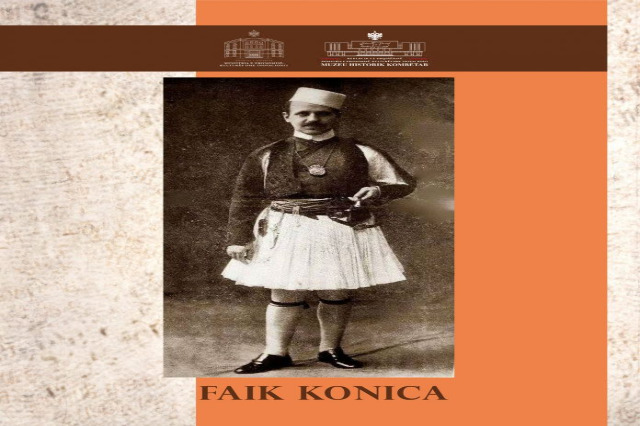
Faik Konica is remembered today on the 149th anniversary of his birth (March 15, 1875 – December 15, 1942). He was a writer, literary critic, publicist, essayist, translator, and one of the most outstanding personalities of Albanian culture, literature, and political life. He was an intellectual of European dimensions.
Faik Konica was born on March 15, 1875, in Konica, into an old Konica family. After receiving his first lessons in his hometown, he attended the Xaverian Jesuit College in Shkodra and then studied at the French Imperial Lyceum in Istanbul.
After completing high school in France, Faik Konica continued his studies in Dijon, specializing in Romance philology. He then graduated from Harvard University in the USA, where he received the degree of “Master of Arts.”
In 1897, Faik Konica published the first issue of the political, cultural, and literary magazine “Albania” in Brussels.
After his move to Boston, he and Fan Noli founded the Dielli newspaper, an important organ of the Pan-Albanian Federation “Vatra.” In 1912, on behalf of the Vatra Federation, he went to London to defend Albanian national interests at the Conference of Ambassadors.
In 1921, Faik Konica was elected chairman of the Vatra Federation, and upon regaining control of the Dielli newspaper, he wrote in one of his columns “Shtylla e Konitzës.”
In 1926, Faik Konica was appointed Minister Plenipotentiary of Albania in the United States.
Faik Konica died in Washington on December 15, 1942. In 1995, after the fall of the communist dictatorship, his remains were brought to Tirana.
With his literary work and critical writings, Faik Konica reflects a deep understanding of the Albanian mentality and political life. Throughout his career, he strove for a common literary language and helped enrich the development of the literary and journalistic style of written Albanian. While much of his work remains published in the press of his time and in manuscripts, Faik Konica remains a central figure and a reference point in the progress of Albanian modern culture.
/m.ll/
Të ngjashme
Latest News
Most read





 RTI
RTI