
 English
 Français
  Deutsch
 Italiano
 Turkish
 Greek
Greek Serbian
200 years ago, the English romantic poet Lord George Byron passed away




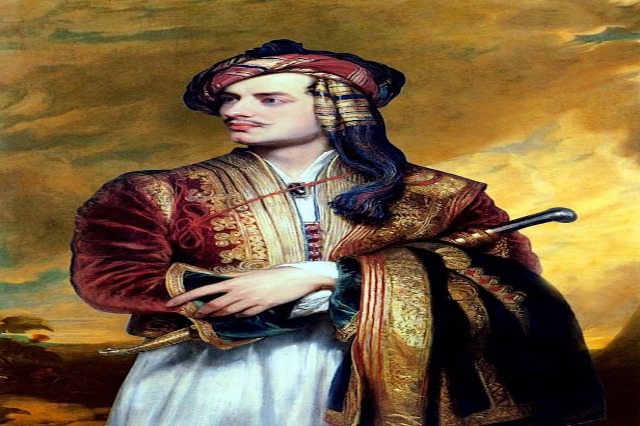
Byron was born in London, on January 22, 1788, into an impoverished aristocratic family. At ten, following the death of his father, Byron inherited the title of Lord and the manor house of Newstead Abbey.
At Harrow he studied Greek and Latin, history and English literature. At the age of 18, Byron entered Cambridge University (Trinity College). In 1809 he took his seat in the House of Lords, where he was noted for his progressive ideas. In the same year, he undertook a trip through Europe. During his visit to Southern Albania, and especially to Janina/Ioannina, Lord Byron purchased a traditional Albanian costume as a souvenir from those times. It would be precisely the beauty and uniqueness of this costume that in the summer of 1813 would push the painter Thomas Philips to paint the famous portrait of Lord Byron wearing the Albanian costume, entitled “Portrait of a nobleman in Albanian clothing”. The portrait was placed in the Royal Academy.
Among his literary works, an important place is occupied by the poem “Childe Harold’s Pilgrimage”, published between 1812 and 1817, and written based on impressions from the poet’s travels in Spain, Greece, Albania, Switzerland, Italy, etc. In it, Lord George Byron sang also to the traditions and manly customs of the Albanians, their bravery and ardent love for freedom.
Byron was the first great poet to visit Albania. He incited the curiosity of a number of foreign travelers, poets and artists on Albania and the Albanians.
Land of Albania! Where Iskander rose,
Theme of the young, and beacon of the wise,
And he his namesake, whose oft-baffled foes
Shrunk from his deeds of chivalrous emprize;
Land of Albania! let me bend mine eyes
Oh thee, thou rugged Nurse of savage men!
(From Child Harold’s Pilgrimage, Canto II, Stanza 38)
The National History Museum brings a part of the letter sent to his mother on November 12, 1809, where, among other things, Byron writes: “… I love Albanians very much. On the trip I made, I guarded once for two days, and again for three days, in an Albanian barracks, and I have never found soldiers as popular as the Albanians, although I have been to the garrisons of Gibraltar and Malta, and I have seen most Spanish, French, Sicilian and English soldiers. They did not steal anything from me, and they gladly invited me to take it from their zahir and their milk …“
In 1823, Byron left back in the Balkans, inspired by the struggle for national independence against the Ottomans. He did not manage to see liberation, because he fell ill with fever and died in Mesolonghi, on April 19, 1824, at the age of 36.
/a.p./
Të ngjashme
Latest News


Most read








 RTI
RTI