
 English
 Français
  Deutsch
 Italiano
 Turkish
 Greek
Greek Serbian
32nd anniversary of the death of the Albanian writer and albanologist, Martin Camaj




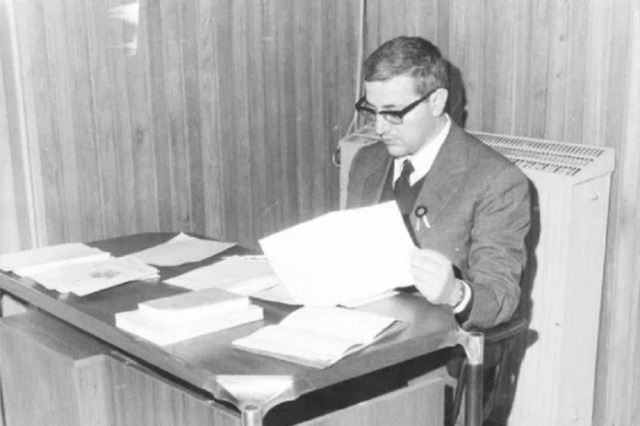
Today marks the 32nd anniversary of the death of the Albanian writer and albanologist, Martin Camaj, in Munich. Camaj’s academic research focused on the Albanian language and dialects, particularly those of southern Italy.
His literary career spanned 45 years and underwent several stages of development. He began with poetry, a genre to which he remained faithful throughout his life. In his later years, he focused more on prose.
Martin Camaj was born in Dushman of Dukagjin on July 13, 1927, in a place called Telumë. The date of birth 1925 appears to be a typo. His birthplace is described by Camaj himself as “… in a wild valley, ‘where a horse’s hooves have never stepped’, this place is so fragile.”
He spent the first ten years of his life in his hometown, where he began acquiring his first knowledge of reading and writing Albanian and mathematics in a self-taught manner. This caught the attention of the ex-baptist Fr. David Pepa OFM, who urged him to intercede with the higher authorities in Shkodër to undertake education and, why not, prepare for the priesthood.
In 1935, he finally settled in Shkodër and began receiving regular education at the Jesuit college “Xaverianum,” where he also suffered from tuberculosis. The rector of the college at that time was P. Giuseppe Valentini SJ, from whom we learn that he completed the 5-year primary education in 4 years.
For the next five years, he regularly attended the gymnasium, which earned him the right to continue his studies at the college’s classical lyceum. Unfortunately, his father passed away a few years after young Martin entered college.
He was forced to halt his studies in the third year, in 1946, after the closure of the religious institutes in Shkodra. He founded a school in Prekal, where he served as the sole teacher until 1948.
Camaj participated in the resistance against the communist partisans with the squad of Captain Gjon Destanishte. In August, he was forced to live illegally until he managed to escape to Yugoslavia together with Father Daniel Gjeçaj and a group of 36 people. After this, he no longer had the chance to contact his family; one of his brothers served 30 years in prison. He completed an intensive teaching course in Peja for three months (July 1 – September 30, 1949), then worked for a year (1949-1950) as a teacher at the “Mahmut Lekiq” school in Tuz.
In 1950, Martin was in Belgrade, where he enrolled at the university of the Yugoslav capital. He graduated after five years on July 2, 1955, taking diploma exams in the field of Romance philology with Italian language and literature as his main focus. In June 1951, he married teacher Nina Bogdanovic, first in the municipality, then in the Orthodox church, and finally in the Catholic church.
After completing his studies in Belgrade, Camaj prepared for postgraduate training in Albanianology at the Faculty of Philosophy of the University of Sarajevo, under the guidance of the albanologist Prof. Henrik Bariç, who was also the head of the Albanological Institute in Sarajevo.
In collaboration with Prof. Henrik Bariç and the second mentor, Prof. Rikard Kuzhmič, Camaj decided to pursue his doctoral studies in philology by selecting “The Language of Gjon Buzuku” as his topic. The corresponding request of his mentors was approved by the scientific council of the faculty in a meeting held on February 16, 1956.
That same year, seeing the declining health of the professor and the difficult situation in the Federal Republic, he went to Italy (at least as early as September 20, 1956), where his wife was forced to have a kidney removed due to illness.
Under the mentorship of Koliq, on March 15, 1960, he defended his doctoral thesis on Gjon Buzuku’s “Meshari” with the highest honors at the University of Rome. The thesis was published that same year as an edition of the magazine “Shêjzat” (which he edited for three years and would continue to do so until 1971) under the title: Il Mesale di Gjon Buzuku. Contributi linguistici allo studio della genesi.
The final separation with Martin occurred in 1968, after which Nina returned to Milan, where she lived until November 1987. The years from 1965 to 1971 were crucial for the consolidation of Albanology as a complex field of scientific research.
In 1969, he married Erika, with whom he did not have children. On July 16, 1971, he was appointed as a non-ordinary professor in Albanianology. Then, on September 14, 1978, he was appointed as a full-time professor with permanent employment. He was later released from his position as a meritorious professor on September 30, 1990. He lived in Lenggries, a place that reminded him of the lands where he was born. He passed away on March 12, 1992, in Munich.
Martin Camaj is included in almost all anthologies and works that discuss Albanian writers. His academic research focused on the Albanian language and dialects, particularly those of southern Italy. His literary career spanned 45 years and underwent several stages of development. He began with poetry, a genre to which he remained faithful throughout his life. In his later years, he focused more on prose.
His first volume of classical verse, “Nji fyell ndër male” (A fiddle among mountains), published in Prishtina in 1953, and “Kânga e vërrinit” (Song of lawns), published in Prishtina in 1954, were inspired by the inhabitants of the areas where he was born, the mountaineers of the north, whom he remained spiritually close to even after many years in exile and the impossibility of returning.
Following his early works, Camaj published “Djella” in Rome in 1958, a short novel about a teacher’s love for a young girl. This was followed by the collection of poems ” Legjenda,” published in Rome in 1964, and ” Lirika mes dy moteve,” published in Munich in 1967. This lyric included some poems from ” Kânga e vërrinit,” which were later reprinted in “Poezi” 1953-1967, published in Munich in 1981.
Camaj’s mature verse reflects the influence of the hermetic movement of the Italian poet Giuseppe Ungaretti. The metaphorical and symbolic aspects of his language increase over time, as does the range of his poetic themes.
A selection of Martin Camaj’s poems was translated into English by Leonard Fox and published in the volumes ” Poezi të zgjedhura,” (Selected Poetry) New York 1990, and “Palimpsest,” Munich & New York 1991.
/m.ll/
Të ngjashme
Latest News





Most read









 RTI
RTI