
 English
 Français
 Deutsch
 Italiano
 Turkish
 Greek
 Serbian
What were the Albanian driving licenses like in 1925?




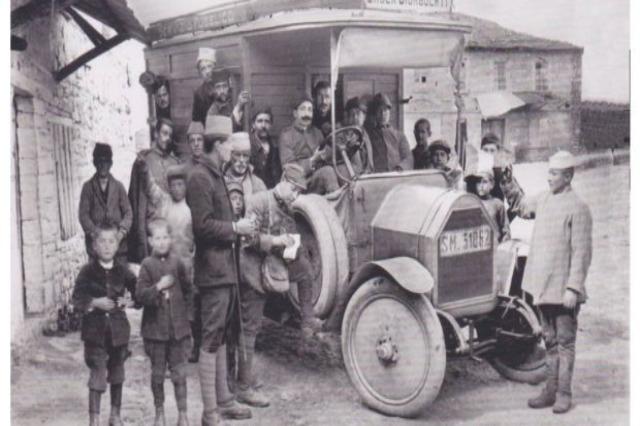
In 1925 Albania adopted a detailed regulation on how to issue licenses, how to obtain a vehicle license, the fees to be paid and the penalties faced by those who violated traffic rules.
According to the regulation, all motor-powered carts operating on roads in public places had to be under the control of the competent government authorities. Anyone wishing to maintain and use motor-powered carts had to obtain a permit from the government. The permit was obtained after the applicant went himself to the competent state authorities and passed the proficiency test.
“Every motorcycle operating on roads or world (public) places had to be equipped with an operating license, called “Chaufferi License”. The regulation was so detailed that it provided for the safety elements that the vehicle had to contain.
“Every motorcycle must have an audible signal device. “Each chariot with engine power will have two lamps in front and one for lighting” was further defined in the regulations.
According to the regulations, “within the cities” Chauffeuri “will not exceed 10 kilometers per hour. Outside the cities no more than 40 kilometers per hour ‘. The speed should not exceed 6 kilometers per hour when the weather was foggy or when the car was passing at intersections.
The price of the ownership certificate was 50 gold francs. Anyone wishing to obtain a driving license had to make an application to the competent authorities. The documentation that had to be submitted was the birth certificate. The first condition was that the candidate had reached the age of 21 years. Also, the candidate should have not committed crimes and for this the submission of a “criminal record” or criminal record no later than 2 months was required.
The list of documents included a medical certificate as well released by the doctor of the government or the municipality, confirming that the candidate had no physical or health defects that could deprive him of the driving of the vehicle.
The license test consisted of two phases, as in the present day; theoretical and practical testing. The theoretical exam consisted of various verbal questions. Meanwhile, the practice test was conducted by leading the candidate to drive the vehicle on the road where there were more traffic difficulties. The “Chauffeur Certificate” cost 20 francs. This regulation entered into force on September 1, 1925. (Scan)
/Klara Ruci/
Të ngjashme




Latest News









Most read










 RTI