
 English
 Français
 Deutsch
 Italiano
 Turkish
 Greek
 Serbian
Spiropali: Religious Tolerance, a Factor of Social Cohesion and a Model for Political Conduct




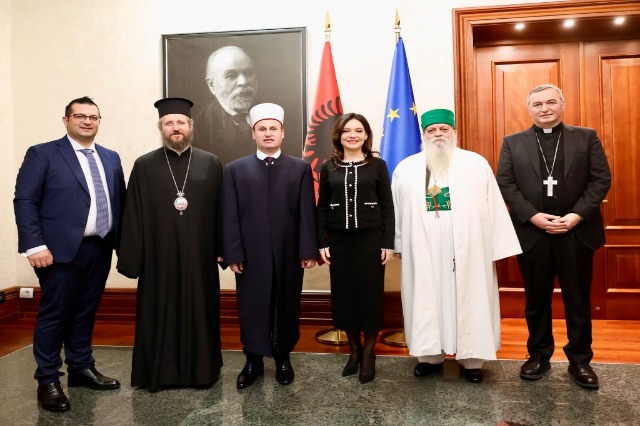
On the eve of International Human Rights Day, Speaker of Parliament Elisa Spiropali hosted a meeting with leaders of Albania’s religious communities at the Parliament’s Presidency.
The meeting included representatives such as Bujar Spahiu, Chair of the Muslim Community; Haxhi Dede Edmond Brahimaj, Worldwide Leader of the Bektashi Order; Monsignor Arjan Dodaj, Metropolitan Archbishop of Tirana and Durrës; His Grace Asti, Metropolitan of Berat; and Ergest Biti, Head of the Evangelical Brotherhood.
Spiropali highlighted the importance of religious tolerance as a cornerstone of Albania’s identity and a model for political and social harmony.
“We discussed strengthening social infrastructure to create a better, more humane, and just society. Religious tolerance must guide political behavior, rejecting the language of violence, denigration, and hatred, which have no place in Parliament or public life. Additionally, we explored ways to collaborate in combating violence in society and families, emphasizing a citizen-centered approach,” Spiropali stated.
Reflecting on the significance of International Human Rights Day, Spiropali stressed the role of religious communities in safeguarding not only freedom of belief—a fully guaranteed right in Albania—but also in promoting fundamental rights to build a fairer society.
“Albania’s religious diversity is one of its greatest assets. The harmony and mutual understanding among faiths are a defining feature of our nation, recognized globally as a shared home for religious communities. This harmony is an example for others and a crucial factor in our social cohesion. It should also serve as a model for political unity, inspiring politicians and parliamentarians to adopt a similar approach. The language of violence and hatred has no place in our society,” she emphasized.
Spiropali also called for stronger collaboration between Parliament and religious institutions to enhance social infrastructure. She emphasized priorities such as supporting families, fostering healthy relationships, providing educational and cultural services, and combating domestic and societal violence.
“This partnership must place families, individuals, and citizens at its core,” Spiropali concluded.
Të ngjashme
Latest News



Most read










 RTI