
 English
 Français
 Deutsch
 Italiano
 Turkish
 Greek
 Serbian
Governor Sejko Meets Counterpart Holzmann: Austria Accounts for 6% of Total Foreign Direct Investments




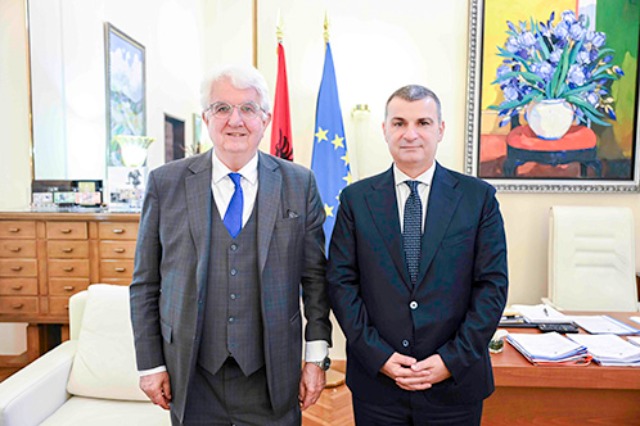
Robert Holzmann, Governor of the Austrian National Bank, visited the Bank of Albania today, marking a significant step in strengthening bilateral relations between the two institutions. The meeting took place under the auspices of Governor Sejko at the Bank of Albania.
Governor Sejko highlighted the strong ties between Albania and Austria, noting that Austrian foreign direct investments constitute approximately 6% of total foreign investments in Albania, significantly contributing to the financial sector. He expressed gratitude for Austria’s support in Albania’s European Union integration and conveyed optimism about further developing economic and technical cooperation.
Additionally, Governor Sejko briefed his counterpart on the latest macroeconomic developments in Albania, recent reforms, and future expectations. He pointed out that despite facing challenging circumstances, the Albanian economy is on a positive growth trajectory, with economic activity rising by 4.1% in the second quarter. While inflation remains low, it is expected to gradually return to the Bank of Albania’s target in the first half of next year. Both the private sector and banking sector are in a healthy financial position, and improvements have also been noted in the external sector’s balance, with external debt at its lowest levels in a decade.
Focusing on the banking sector, Governor Sejko emphasized its liquid and well-capitalized financial balances, which exhibit high resilience to potential shocks. He attributed these positive developments to the prudent monetary policy of the Bank of Albania and its continuous oversight of the banking sector.
He also mentioned that the euroization of the financial system significantly impacts the effectiveness of economic policies. To this end, the Bank of Albania, in collaboration with the Albanian government, has implemented measures aimed at increasing the use of the national currency within the financial system and the broader economy.
Regarding Albania’s EU integration process, Governor Sejko noted that one of the strategic objectives of the Bank of Albania is to modernize payment systems, specifically by joining the Single Euro Payments Area (SEPA). He stated that the Bank has successfully met all legal and regulatory requirements and finalized its application process in June 2024. Concurrently, work is ongoing on the instant payment project, with close collaboration between the Bank of Albania, the Bank of Italy, and the European Central Bank.
Both governors underscored the economic ties that most countries in the region, including Albania, share with the Eurozone, highlighting their financial exposure and synchronized economic cycles. The financial systems in the region demonstrate a high degree of integration and dependence on the Eurozone’s monetary, supervisory, and regulatory policies.
During the meeting, attendees discussed the new growth plan for the Western Balkans and its importance in the context of Albania’s European integration.
Holzmann commended the role and prudent monetary policy of the Bank of Albania, which has allowed Albania to maintain one of the lowest inflation rates and one of the highest economic growth rates in the region.
He also acknowledged the reforms undertaken by the Bank of Albania in the framework of the country’s European integration efforts. As an advocate for sustainable tourism, Holzmann stressed the importance of focusing on this sector, noting that sustainable tourism not only benefits the environment but also strengthens local communities and supports long-term economic growth.
/a.p./
Të ngjashme

Latest News









Most read










 RTI