
 English
 Français
 Deutsch
 Italiano
 Turkish
 Greek
 Serbian
Anti-Corruption Assembly Committee: Xhafaj Announces Formation of Expert Reforms Subgroups




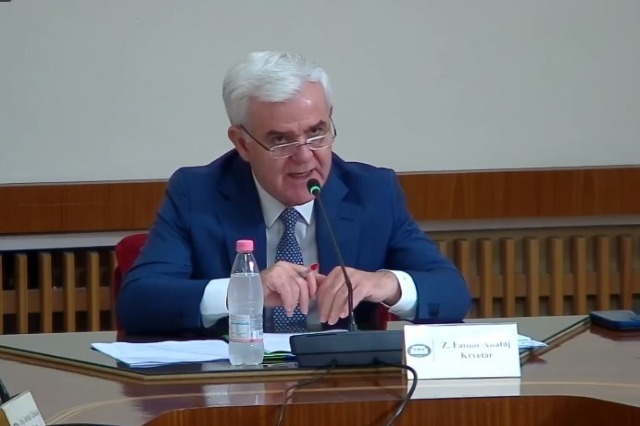
Fatmir Xhafaj, Chairman of the Special Anti-Corruption Assembly Committee, told today that the list of high-level experts tasked with drafting an analytical document will be approved next week. This document will address three main pillars: governance, anti-corruption, and the rule of law.
During the meeting of the special Assembly Committee “For Deepening Reforms on Governance, Rule of Law, and Anti-Corruption for Albania 2030 in the European Union,” Xhafaj pointed out that, “Over the past month since the committee’s establishment, we have been working diligently to prepare the necessary organizational measures“.
“We are now taking a crucial step forward, initiating the first phase of our work, which involves preparing the analysis. To ensure the document’s focus on key issues, a concept note has been prepared outlining its content. This project will be further developed by the expert group, which will be divided into three subgroups based on the three main pillars,” he said.
Xhafaj noted that the high-level experts will be selected based on proposals from academic world, civil society, interest groups, and independent institutions. This thorough analysis will shape and provide content for the document.
“The process will be guided by four key principles. First is inclusiveness. This means not only involving all parliamentary political groups but also engaging all relevant stakeholders, including civil society, the business community, independent institutions, law enforcement agencies, and other interested professionals,” Xhafaj added.
The second principle guiding the process will be transparency.
“The third principle is professionalism. The expert group will consist of top experts in governance, anti-corruption, and the rule of law. We will approve the composition of the expert group next week,” he said.
Xhafaj also underscored that the entire process and its outcomes must align with international standards and criteria.
Committee member Milva Ikonomi highlighted that significant efforts have been made on the governance pillar.
“Governance must be built on public administration reform, accountability to citizens, online service delivery, and financial transparency. We need input from civil society and technical groups. We need well-prepared individuals to serve in administration roles. The administration must be capable of market oversight. We have already started addressing various local government issues, and recommendations need to be fulfilled,” she said.
While, member Evis Kushi stated that digitizing services is a top priority for the government to improve accessibility and reduce corruption. Kushi also emphasized the importance of utilizing Artificial Intelligence to its fullest potential.
/a.p./
Të ngjashme




Latest News






Most read










 RTI