
 English
 Français
 Deutsch
 Italiano
 Turkish
 Greek
 Serbian
Joyful retrofit project uses humor to heal deep wounds




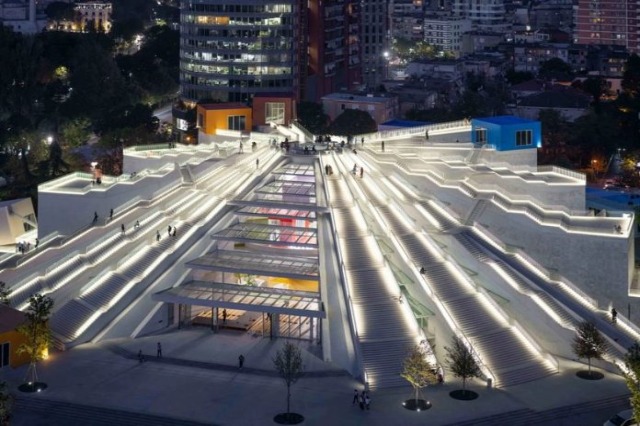
Originally built as a museum for communist dictator Enver Hoxha, MVRDV has reused the concrete structure to dramatically transform The Pyramid of Tirana into an open sculpture in a new park.
The WAN Awards EMEA judges described it as a “fearless project” that “reaches out to the public”, saying it displayed “joyful use of retrofit”.
The park and the sculpture are home to an ensemble of colourful boxes, scattered in and around the original building and now housing cafés, studios, workshops, start-up offices, incubators, festivals, and classrooms where young people can learn various technology subjects for free.
Steps have been added to the building’s sloping façades, allowing the people of Albania to literally walk all over the showpiece of the former dictator.
Its various uses since the fall of the communist regime left behind a patchwork of alterations that made the interior cluttered and dark. The majority of Albanians were opposed to demolishing the building, and their desire was honoured when the government announced plans to transform the concrete monolith. For many the Pyramid is a symbol of victory over the regime, and the new design was inspired by the way they had reclaimed the building.
WAN Awards EMEA judge Eva Jiricna said that the project made her smile.
The Czech-born veteran architect said: “Having been born in a country which has gone through similar historic events and having witnessed the struggle when it comes to dealing with buildings left by the previous regime, hated by some and admired by the others, a sense of humour seems to be an answer.”
She added: “There is no hatred any more just a jokingly funny solution, useful, well needed for contemporary life and very well used by anybody ( those who remember and those who never want to know). Well done to the designers for such a good solution to teach the public that a sense of humour can heal even deep wounds.”
Design highlights
The transformation of the Pyramid shows how a building can be made suitable for a new era, while at the same time preserving its complex history. Rather than wastefully demolish the structure, its robust concrete shell is adapted along circular economy principles. Huge, tiered glass flaps replace the glazing between the Pyramid’s concrete beams, protecting the interior from rain while keeping it open to the elements.
Të ngjashme


Latest News


Luxury cruise ship Explora 2 makes first call in Saranda



Most read










 RTI