
 English
 Français
  Deutsch
 Italiano
 Turkish
 Greek
Greek Serbian
US survey: Albania and Kosova, the most pro-West countries in the Western Balkans




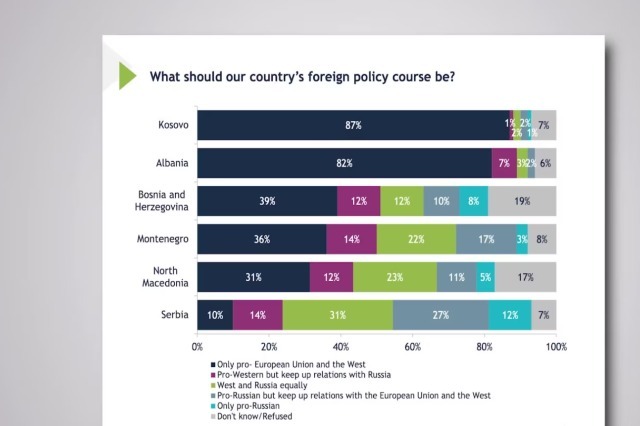
In a recent survey of six Western Balkan countries, the US International Republican Institute found broad pro-Western support among Albanians in Albania, Kosova and other countries in the region where they live. But, according to the director for Europe of this institute in Washington, in great contrast to this pro-European Union and NATO orientation, stands Serbia, while support for the pro-European course has softened in countries like North Macedonia and Montenegro, both NATO member states.
Kosova and Albania are the most pro-Western countries in the Balkans.
In a region where support for the Euro-Atlantic orientation is wavering in the face of delays in integration or pro-Russian sensitivity, within the Albanian public the western course continues to be considered the only direction.
Relative to Kosova, 87 percent of respondents say that their country should follow a foreign policy that is compatible with the European Union and the West, while in Albania, where the survey was conducted for the first time, this direction is supported by 82 percent of respondents.
At the bottom of the list is Serbia, where public opinion is polarized, with only 10 percent of respondents in favor of a pro-Western course and a majority aiming for a balanced policy between the EU and Russia. The survey was conducted during February and March of this year.
In an interview for VOA, the director for Europe of the International Republican Institute, Paul McCarthy, says that in all six states of the region, support for the EU remains strong, with some important exceptions.
“Serbia differs from the other five states of the region, being the most pro-Russian, blaming the West for the conflict in Ukraine and with very low support for European Union membership. On the other hand, we see very pro-Western attitudes among the Albanian population in the region, in Albania, in Kosova and in the countries where they live, such as North Macedonia and Montenegro. A similar very pro-Western orientation, although a little less, is also found among the Muslims of Bosnia, where Turkey ranks as the most supported country, while the United States comes second to this population,” he says.
But in the case of a referendum for membership in the European Union, in all the states of the region support is observed by a solid majority, while in countries such as Albania, Kosova and Montenegro, membership is supported by an overwhelming majority. They differ in the belief they have if the European Union really aims at their integration.
Director McCarthy says support for NATO membership remains strong, with the exception of Serbia, and weaker-than-expected support for NATO in North Macedonia and Montenegro, as well as for the role that NATO has played for these member countries. In Albania, 64 percent of respondents think that membership in NATO is very positive for the country, while in North Macedonia, 32 percent of respondents give such an assessment, while in Montenegro, this figure is only 28 percent.
In Kosova, which has recently experienced a flare-up of tensions with Serbia, support for NATO membership has risen by 13 percent since last year. In Serbia, the support for membership in NATO this year is only 3 percent.
“The long wait has made the residents of these countries lose patience to join the European Union. Part of this is also explained by the fact that Ukraine and other countries were invited, while in most cases the countries of the Western Balkans have been waiting in line to join the EU for over two decades. In my analysis, support for the EU is starting to fade in places where it was very, very strong,” according to McCarthy.
In Serbia, Mr. McCarthy says, this support has shrunk, but according to him, since the Russian invasion of Ukraine, public opinion in this country has become even more polarized and the opposing pro-West and pro-East attitudes have increased. The anti-EU approach in Serbia, according to McCarthy, is also being fueled by the government, which feeds this sentiment through the media, emphasizing relations with authoritarian foreign actors such as Russia and China.
But who is an ally and who is an enemy?
Regarding Albania and Kosova, the most important ally is the United States, while in regards to North Macedonia; the most important ally is Serbia, and the same goes for Montenegro. In respect to Bosnia, Turkey is now the most important ally, while to Serbia it is Russia. For the vast majority of respondents in Kosova, Serbia remains the main threat, while in Albania the majority sees Serbia and Russia as threats. In North Macedonia, the main danger is Bulgaria, while in Montenegro, the United States and Russia. Serbia poses a danger in Bosnia, and in Serbia, the United States, Kosova and Albania.
This overview of the region, according to McCarthy, requires a commitment from Washington and Brussels to offer all the countries of the region membership with an accelerated step.
“It would be a mistake, for example, to leave Serbia behind while everyone joins. It will not happen overnight and it will take time, but we cannot leave Serbia out while we move forward, because for the stability of the Balkans, it is necessary for Serbia to be with the West, to be in the EU and eventually in NATO, because in many ways it is the center of the Balkans, the largest country, and the countries around it, especially those with Serbian minorities within them, will never feel safe as long as Serbia is not oriented towards the West,” he says.
According to McCarthy, Russia is trying to destabilize the Balkans to distract the West’s attention from supporting Ukraine.
/a.p./
Të ngjashme

Latest News





Most read




 RTI
RTI