
 English
 Français
 Deutsch
 Italiano
 Turkish
 Greek
 Serbian
The Agriculture support scheme, Minister Denaj tells for the RTSH the priorities for 2024




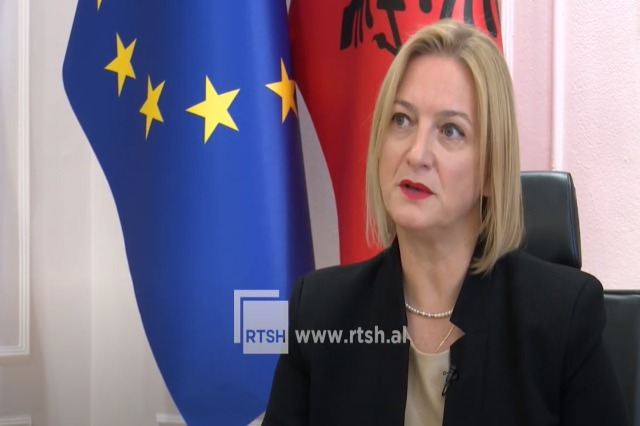
The Albanian government has planned to support the agricultural sector through a special financing scheme, which has had support and opposition from a certain number of actors of political life and the sector too.
March 27 is the date when this scheme starts working. In a special interview for the Albanian Radio and Television (RTSH), the head of the agriculture department explained all the implementation details of this scheme.
“The problem we have had for 32 years is the high rate fragmentation of [agricultural] land and there may be many reasons for that, while the present average is 1.1 hectares per farm. In respect to the set objective to achieve a quality standard for the international markets, neither new technology can be introduced to small farms, nor quality products can be produced at an optimal cost if the agricultural surfaces are small. When we talk about an average of 1.1 ha, it means that there are significant areas of land that are below this level, while the issue of automating the processes becomes even more difficult. This is not an easy process, as we come with a mindset that the merger may bring problems between the parties. We put forward the National Scheme as an incentive to merge, to bring more production and quality, but that does not mean that those who will not join will not benefit from the National Agricultural Scheme. Unions of [agricultural] operators, not necessarily agricultural unions, are not really unions made in difficulty for land farmers or cattle breeders. We are not looking to unite the properties differently from the Agricultural Cooperative Companies,” clarifies Minister of Agriculture and Rural Development, Anila Denaj.
Albania is financing agriculture less than any country of the region. An FAO study qualifies this funding as 18 times less than neighboring countries. In that regard, Minister Denaj has an explanation:
“We cannot compare schemes that do not have a complete picture. If I am going to compare the national scheme with another state, I have to do an analysis of all other support schemes, including IPARD (Agricultural and Rural Development Program). At this point, if we compare with Kosova, the support that goes directly to the sector should be seen both in relation to the support scheme for raw material production and processing through investments, including access to finance. Since 2016, the Albanian government has been involved with funds to guarantee loans, just like during the pandemic period. Not all farmers know that there is such a guarantee scheme,” said Denaj.
The support scheme is proportional, while Minister Denaj says that there is no ceiling in funding. Here is the example given by the head of the agriculture:
“There is room for more [funding from the] budget, but I am confident that the budgets beyond the ceilings are increasing. Last year there were 51 million USD from 10 million USD 10 years before and 33 million USD more than a year ago. This is viewed from a perspective. It is very important and a recommendation of Prime Minister Rama to assure effectiveness of the measures and of the instruments, including the fiscal ones. We have a high level of informality and I continue to say that not only Agricultural Cooperative Companies but also the schemes of operators who join in a contract of interest to work in the same market, with the help of FAO, we are launching a legal product which I believe by November will I give us some instruments so that when the fiscal package is prepared, we can put these operators’ unions in focus to set priority only where there is formality, the quality product and we have traceability,” said Denaj.
The national scheme does not meet the entire demand of the agricultural sector for necessary financing. IPARD 3, a European support scheme, will soon become effective. This is how the goal of 1 billion Euro Albanian exports will be achieved:
“We in Albania, but also in the region, cannot increase our agricultural economy without the assistance of the EU. IPARD 2 showed that if we went from a small farming system to a more advanced one, it was thanks to the construction of greenhouses that today cover 2200 ha; while in 2014, the surface was 1000 ha. By 2030, we want to reach to 4400 ha. 4,400 hectares of greenhouse production leads us to the goal of 1 billion USD of [agricultural] exports,” said the minister.
/a.p./
Të ngjashme



Latest News









Most read










 RTI