
 English
 Français
 Deutsch
 Italiano
 Turkish
 Greek
 Serbian
Albanian Presidency of the UN Security Council, Minister Hasani: Establishing the Humanitarian Alliance in the private sector




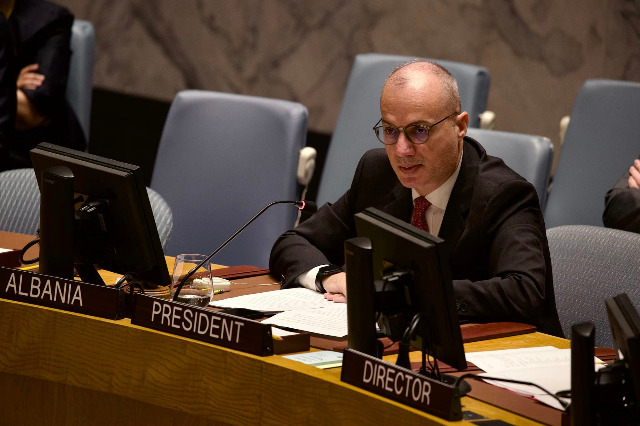
As part of the Albanian Presidency of the UN Security Council, Minister for Europe and Foreign Affairs Igli Hasani delivered a statement to the media in New York. He discussed the High-Level Open Debate of the Security Council, focusing on the “Promotion of Public-Private Partnerships in Addressing Humanitarian Challenges,” an initiative spearheaded by Albania.
As the President of the UN Security Council for the month of September, Albania is hosting a High-Level Open Debate titled “Promotion of Public-Private Partnerships.” “Honored to chair the High level Open debate on Advancing public-private humanitarian partnership, an initiative of Albania, ” cited Hasani.
“This is due to one major reason: the world is grappling with an unprecedented level of humanitarian needs, driven by various factors, including poverty, instability, conflict, and climate change,” he emphasized.
“Despite the ongoing commitment and generosity of numerous loyal donors, experience has revealed that millions of people worldwide still lack adequate support. Reports indicate that approximately 300 million people are in dire need, with many uncertain about when they will have their next meal. We must not and cannot abandon them,” said Hasani.
This, he added, “is the reason why we all must do more, better, and faster.”
Therefore, Hasani continued, ” It’s imperative to identify gaps and explore mechanisms to formalize the role of corporations and philanthropies in the crisis response ecosystem.”
“We believe that the expertise of the private sector will play a crucial role in humanitarian operations. Advancing public private humanitarian partnership is not only necessary but the right thing to do and it building a Private Sector Humanitarian Alliance support this goal,” highlighted Hasani.
He remarked that “this Open Debate aims to identify ways to strengthen the role of the private sector and harness its potential in response operations. It seeks to advance solutions through public-private partnerships to address emergency needs and, in turn, promote international peace and security. Over the last two years, in collaboration with like-minded countries and partners, we have been working to explore untapped potential and available resources.”
Hasani also announced the establishment of the Private Sector Humanitarian Alliance as a coordinating body to respond to humanitarian crises. It will serve as a central entry point for the private sector within the humanitarian architecture, including the UN.
“Through the Alliance, we aim to involve corporations and philanthropic organizations, in collaboration with key UN agencies and civil society, in order to document and gather feedback on critical gaps and areas for improvement in crisis response. We will explore mechanisms to formalize the involvement of corporations and philanthropies in the crisis response ecosystem to enhance resource utilization and strengthen response efforts,” he stated.
“It is a first step, but we believe it’s a bold one to showcase the public sector’s expertise in addressing complex crises and to establish more comprehensive, flexible, and effective solutions that can respond effectively to the increasing needs,” Hasani elaborated.
/m.ll/
Të ngjashme
Latest News


Most read










 RTI