
 English
 Français
  Deutsch
 Italiano
 Turkish
 Greek
Greek Serbian
Tensions in the north of Kosova, Escobar: They can turn into a regional conflict! Lajcak: If the situation is not de-escalated, we will have victims




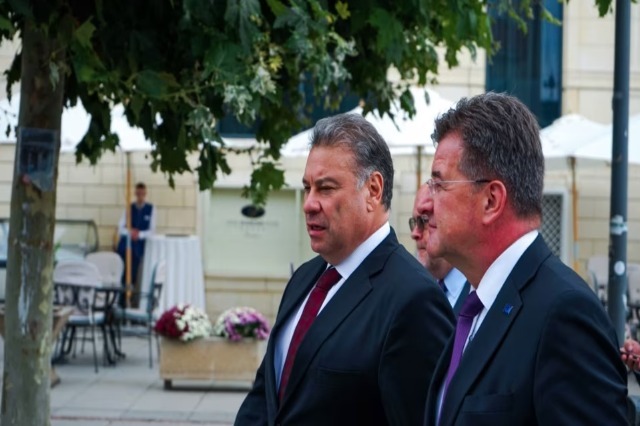
Washington’s envoy for the Western Balkans, Gabriel Escobar, said that the tensions between Kosova and Serbia have the “potential to turn into a regional conflict”.
He made these statements in a debate held by the Atlantic Council in Washington, together with the EU envoy for dialogue, Miroslav Lajcak.
Meanwhile, Lajcak said that the first priority is to de-escalate the situation, “to remove people from the street and return to dialogue”.
“If we fail to de-escalate the situation, we will have victims,” he said.
As for the three Kosova police officers who are in custody in Serbia, Escobar said that even if they were kidnapped or entered the Serbian territory by mistake, they should be released immediately.
Lajcak also supported this position.
Lajcak said that the crisis management meeting in Brussels will be held, despite the statements of the leaders of Kosova and Serbia.
“If it was rejected, there would be serious and negative consequences,” he said, adding that the meeting – which according to him will be held very soon – will focus only on the management of the current crisis. Speaking about the request for new elections in the north of Kosova, Lajçak said that there are two ways: either through the resignation of the current majors in the north of Kosova, or through a referendum. He said that both would follow the laws and the Constitution of Kosova.
“However, until now we have not seen the political will to hold early elections,” he emphasized.
Escobar was asked about accusations that the US and the EU are soft on Serbia and tough on Kosova. But, the American official said that for 15 years, everything that Washington has done has been in favor of Kosova, starting from the acceptance of independence, the campaign for the recognition of Kosova, the acceptance of the last elections in the north.
“I challenge everyone to tell me when we have been tough with Kosova and soft with Serbia. What we are asking from Kosova is close coordination and acceptance of international obligations. I don’t think this can be translated that we are tough on Kosova. I think it’s the opposite,” he said. As for the establishment of the Association of Serb-majority municipalities in Kosova, the two Western officials said that its establishment is an international obligation of Kosova, which must be undertaken on the basis of the Constitution of Kosova.
“I believe in the EU, in European models. We want to jointly draft the statute, which would be based on the best European models. We analyzed 16 European models. Let’s make sure that we create something that is not a monster but that works for Kosova and Serbia,” said Lajçak.
Meanwhile, Escobar said that the US supports an association that does not cause problems in the functioning of the state.
Asked about the way forward for both sides, Western officials said that Kosova and Serbia must respect their obligations arising from the dialogue.
Escobar said that it is important to implement the Agreement towards the normalization of relations – reached in February in Brussels and then the Annex for its implementation in March in Ohrid – through which Serbia, among other things, would recognize the symbols of Kosova and its right to membership in international organizations.
Meanwhile, for Kosovo, he said that it is important to start “immediately and urgently the talks on the establishment of the Association”.
Both officials described as a “serious proposal” the draft statute that the Prime Minister of Albania, Edi Rama, put forward for the Association.
The Prime Minister of Albania, Edi Rama, said on June 8 that he sent a draft for the Association to the President of France, Emmanuel Macron, and the German Chancellor, Olaf Scholz.
Rama said that the document is confidential, but expressed his conviction that it is “a document of the highest international level that takes into consideration all the reasons for the creation of the Association and that the Association is part of the organization of life for Kosova”. This discussion comes two weeks after Escobar and Lajcak stayed in Kosova and Serbia to help the parties reduce tensions.
They presented three demands to the Prime Minister of Kosova, Albin Kurti: the calming of the situation in the north, the holding of new elections in the four municipalities in the north, inhabited by a majority of Serbs, and the return to the dialogue for the normalization of relations, which is mediated by the EU.
Kurti has presented a five-point plan, which includes the possibility of holding new elections. Tensions in the north have been rising since May 26. That day, the Serbs started protests against the entry into the municipal buildings of the new Albanian mayors of Zveçan, Zubin Potok and Leposavic, who entered the buildings with the assistance of the Kosova Police.
Since then, local Serbs have been protesting in the north, opposing the presidents who were elected on April 23 – elections that were boycotted by Serb parties and the population.
On 29 May, the protests escalated into violence, with Serbs clashing in Zveçan with soldiers of the NATO peacekeeping mission in Kosova, KFOR.
On June 14, reports became even tenser after three Kosova police officers were detained by Serbian forces. Kosova says they were kidnapped inside its territory, but Serbia says it arrested them “deep” inside its state. The internationals have demanded the release of the three officers, unconditionally. They are in custody in Kraljevo, Serbia.
Due to rising tensions, the EU has called a crisis meeting this week. However, the president of Serbia, Aleksandar Vucic has refused to meet with the prime minister of Kosova, Albin Kurti. The latter has said that he will not decide to participate in the Brussels meeting, without understanding the condition of the three officers who are being held in Serbia.
/a.p./
Të ngjashme

Latest News
World Bank and Bank of Albania study: Electronic payments could save ALL 38.7 billion annually



 RTI
RTI