
 English
 Français
 Deutsch
 Italiano
 Turkish
 Greek
 Serbian
Freedom House report: SPAK, a promising sign in the fight against corruption




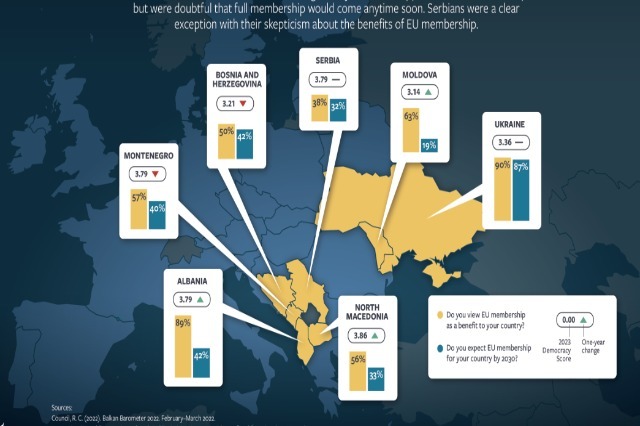
From democracy to corruption, incinerators, the March 6 elections, threats to the media and journalists, were some of the points addressed in the Freedom House report on countries in transit. The report, which classifies Albania among countries with hybrid democracies, states, among other things, that our country has made steady progress towards becoming a full liberal democracy.
“Albania made slight progress during 2022 in terms of democracy, thanks to the increased evaluation in the fight against corruption, but it still remains a country in transition”, it is emphasized in the report of the Freedom House Organization, in which it is stated that, despite this, fundamental problems continue.
Freedom House says that the impact of the war in Ukraine, as a result of Russian aggression, was felt last year in the 29 countries from Central Europe to Central Asia that are analyzed in its report “Countries in Transition”.
In this year’s report titled “War deepens regional divisions” that analyzes developments in 2022 and was made public on Wednesday, it is said that instead of strengthening ties in the region, “security threats, the historic refugee crisis and problems economic problems related to the conflict have deepened the gap between autocracies and democracies and caused disruptive changes in the foreign policies of individual governments”.
As for Albania, the report emphasizes that “the rating for the fight against corruption increased from 2.75 to 3.00 points, thanks to a series of indictments and high-profile convictions of former officials from the Special Structure Against Corruption and Organized Crime (SPAK), as well as its proactive role in promoting the fight against corruption and organized crime”.
This caused the overall rating to increase from 3.75 to 3.79, on a rating scale of 1 to 7 points, where 1 is the lowest level of democracy and 7 is the highest.
However, other indicators of democracy remained unchanged and the report says that Albania’s democratic institutions are challenged by clientelistic party politics, the procrastination of the vetting process in justice and rampant corruption, says the chapter on Albania in the “Countries in Transition 2023” report.
The report emphasizes that new law enforcement agencies such as SPAK, established in 2019, show promising signs in the fight against corruption and organized crime at the highest levels, political influence on the judiciary in corruption cases still remains a concern”.
One of the report’s authors, Alexandra Karppi, told VOA that there was little opportunity for further reforms before the May 14 local elections and that they reinforced the idea that the political status quo was likely to continue.
According to Freedom House’s assessment, “most political parties are dominated by iron-fist leaders, and this lack of internal party democracy was demonstrated in the way candidates for local special elections, local party branch leaders, and election candidates were selected.” for the local elections of May 2023.
The report also talks about reducing the number of courts and the state of the media.
Regarding the new judicial map, Freedom House says that while the international actors who defended the judicial reform in Albania praised the map, it has been severely criticized by numerous lawyers’ associations and civil society, which say that “reducing the number of courts will harm citizens’ access to justice and will increase the cost of the judicial process as some citizens will have to travel over 200 kilometers to reach the court”.
According to Freedom House, Kosovo also marked a slight improvement, but the long-standing strained relations between Serbia and Kosovo continued to undermine democratic progress in both countries, although in different aspects.
The organization Freedom House says that the impact of the war in Ukraine, as a result of Russian aggression, was felt last year in the 29 countries from Central Europe to Central Asia that are analyzed in its report “Countries in Transition”.
In this year’s report titled “War deepens regional divisions” that analyzes developments in 2022 and was made public on Wednesday, it is said that instead of strengthening ties in the region, “security threats, the historic refugee crisis and problems economic problems related to the conflict have deepened the gap between autocracies and democracies and caused disruptive changes in the foreign policies of individual governments”.
/k.s/
Të ngjashme
Latest News

Most read










 RTI