
 English
 Français
 Deutsch
 Italiano
 Turkish
 Greek
 Serbian
OSCE at the discussion table with the Supreme Court and the Constitutional Court




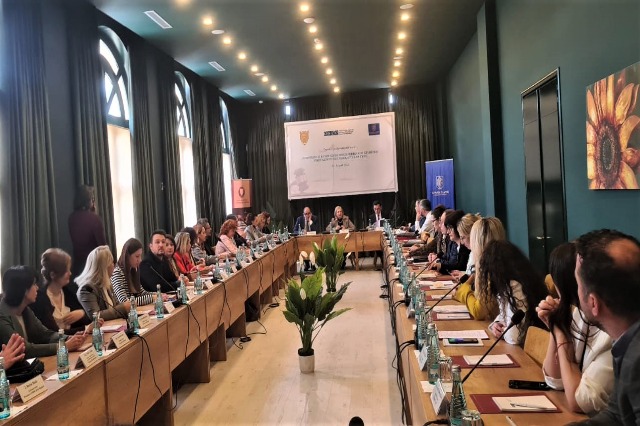
The Constitutional Court of Albania in cooperation with the office of the OSCE Presence in Albania organized a joint discussion table with the Supreme Court on the topic “Constitutional jurisdiction and judicial jurisdiction – meeting points and divisions “.
The bodies of judges of both courts, legal advisers and administrative staff from each of them, as well as representatives of the OSCE Office of Presence in Albania, participated in this activity.
The joint activity opened with the welcoming words of the President of the Constitutional Court, Holta Zaçaj, the Deputy President of the Supreme Court, Sokol Sadushi and the OSCE Presence in Albania ambassador, Guido De Sanctis.
Ambassador De Sanctis congratulated the initiative of the two courts, as well as emphasized the importance it has for creating opportunities for examining technical issues in the relations between the two high judicial bodies.
He pointed out the successful cooperation of the Presence with the Constitutional Court and the Supreme Court and the continuous support it has given to these high judicial bodies.
The works were developed in two sessions, where during the first session the judges of each of the courts referred to the following sub-topics. The range and limits of the constitutional interpretation of ordinary courts, incidental judgment and the nature of the ordinary judge’s assessment, the role played by the constitutional judge in the interpretation of common law to give meaning to the constitutional norm, and the role of the Supreme Court to ensure the uniformity of judicial practice.
The topics covered during the second session focused on the standard of the court determined by law and its implementation in accordance with the constitutional and legal changes that determine the jurisdiction of the Supreme Court for the unification and development of legal practice, the reasoning of the decisions of the consulting room, the nature of the claims presented in the appeal as determining the obligation of the Supreme Court to handle and the cases where the lower courts have given diametrically opposite legal solutions, the right to effective protection of the individual in the Supreme Court, and the trial in the advisory room especially when that court examines, on its own initiative, legal issues without notifying the parties in advance.
The following Q&A sessions, where the judges of both courts asked questions and held discussions related to the referred topics, highlighting the importance of organizing such meetings for the exchange of opinions and the improvement of respective decision-making.
/a.p./
Të ngjashme

Latest News


Most read










 RTI