
 English
 Français
  Deutsch
 Italiano
 Turkish
 Greek
Greek Serbian
Ohrid, Kosova agrees to sign, while Serbia agrees, but hesitates to sign




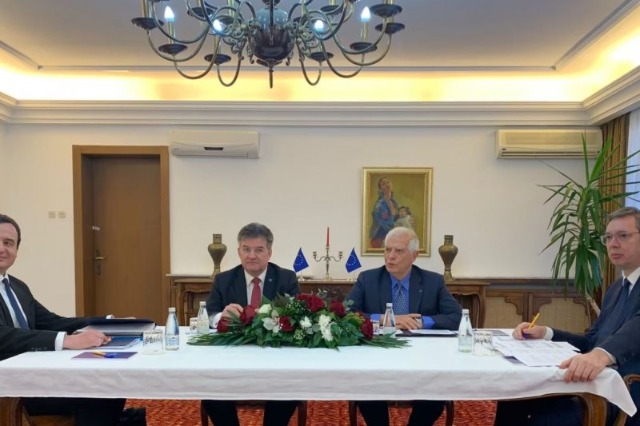
After the marathon talks in Orid on Saturday, Kosova Prime Minister, Albin Kurti said that the agreement reached in Ohrid is a de facto recognition of Kosova statehood by Serbia, while he criticized Serbian President Aleksandar Vucic for avoiding to sign it.
“We came to Ohrid to sign the basic agreement with the implementation annex. We have reached public agreement on an annex that will guide the implementation of the basic agreement. The other side, the same as in the last meeting in Brussels on February 27, is running away from signing. It is up to the EU to find the mechanism to make the status of this agreement legally binding”, said Prime Minister Kurti.
While the head of foreign policy of the European Union, Josep Borrell declared that Kosova and Serbia have agreed on the annex to the implementation of the agreement for the normalization of relations between them, but there was no signature by the parties.
After about 12 hours of difficult talks between Kurti and Vucic, Borrell said that the parties have agreed to respect all the points of the European plan that they agreed on on February 27 in Brussels.
“Kosova has agreed to start immediately, and when I say immediately, I mean immediately, negotiations facilitated by the European Union for a specific agreement and guarantee to ensure an appropriate degree of self-management for the Serbian community in Kosova. The parties also agreed to adopt as a matter of urgency the declaration on missing persons as negotiated within the EU-facilitated dialogue,” Mr. Borrell wrote.
In the meantime, the US envoy for the Western Balkans, Gabriel Escobar said that Kosova and Serbia reached a “difficult but necessary” agreement.
“This not only opens the door for greater Euro-Atlantic integration for both countries, but also opens the door for the region to enter a new era of peace,” said Mr. Escobar.
The leaders of both countries agreed last February in Brussels to the European point plan for the normalization of relations, which for Western diplomacy is considered very important after Russian aggression in Ukraine and concerns that Russia may try to fuel instability in the Balkans by using its influence over Serbia.
/a.p./
Të ngjashme

Latest News













 RTI
RTI