
 English
 Français
 Deutsch
 Italiano
 Turkish
 Greek
 Serbian
EU Continues Role in Preserving Albania’s Cultural Sites with Restoration of Durrës Hamam




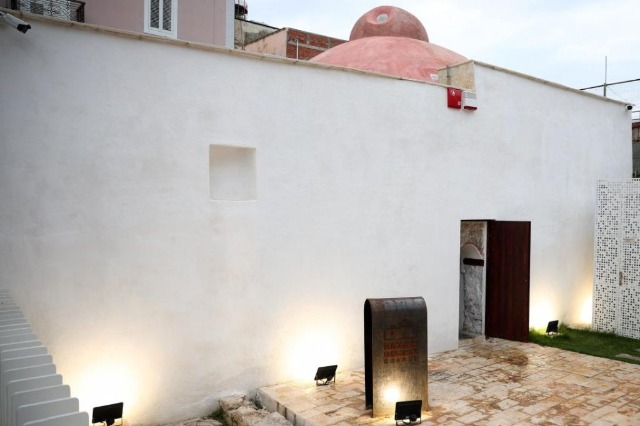
Five years after the 2019 earthquake, the European Union continues to play a key role in building a safer future while preserving Albania’s rich cultural heritage. The Hamam of Durrës, one of many monuments damaged by the earthquake, has now reopened its doors thanks to the EU4Culture program, welcoming many visitors.
Considering its value and significance for the city and Albania, the hamam was selected as one of the 23 sites supported and restored under the “EU for Culture” program.
Built in the 18th century, the hamam is located at the southeastern corner of the medieval city, near the Venetian Tower, and only a few hundred meters from its ancient predecessor, the Roman baths. With three phases of intervention, including the expansion of the main hall, the addition of new columns, and shallow arches in the mid-19th century, a restoration in the 1970s, and modifications for the installation of a café in the early 2000s, many of the original interior elements had already been altered or removed.
Abandoned and closed, the building faced severe damage during the 2019 earthquake. The structure, stemming from three different periods, with masonry added in each historical phase, functioned as three separate structures, causing serious cracks at the joints and side fissures in the dome.
Today, the building is not the complete structure it once was, as parts of the original hamam, including rooms and spaces, are missing, obscuring the full understanding of its original plan and function. However, the remaining sections include parts of the water basin at the back of the building, which runs through the site.
The “EU for Culture” program focused on preserving the surfaces, restoring functional elements, stabilizing the building’s structure, improving the drainage system, and installing modern systems for lighting, monitoring, and security. It also included a multimedia interpretation revealing the sounds of the hamam, showcasing its rituals’ history and significance in Albania. The area around the hamam has been arranged to offer visitors a space to relax and reflect, and it is now connected to the nearby Venetian Tower.
The “EU for Culture” program is funded by the European Union (EU) and implemented by the United Nations Office for Project Services (UNOPS) in close partnership with the Ministry of Economy, Culture, and Innovation. It focuses on the renovation and revitalization of 23 major cultural heritage sites damaged by the 2019 earthquake and represents one of the largest cultural heritage programs funded by the European Union, with a total budget of 40 million euros.
/a.c/
Të ngjashme
Latest News










Most read










 RTI