
 English
 Français
 Deutsch
 Italiano
 Turkish
 Greek
 Serbian
Discover Berat, the Fairytale Town of Albania – Spanish Media ‘La Vanguardia’




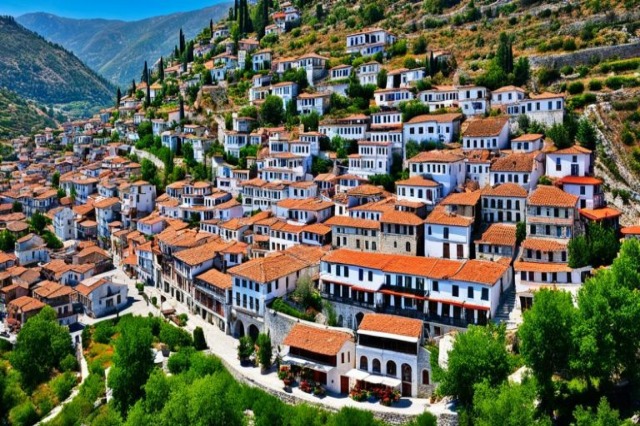
The walls that surround Berat’s castle form a labyrinthine perimeter, where it’s easy to get lost. Yet, no matter the path, all trails eventually lead to the central square of the castle.
Inside the castle grounds, visitors can explore the ruins of defensive structures, the remains of the White Mosque, and the Church of “St. Mary of Vlacherna,” the oldest in Berat.
The Church of the Holy Trinity is located outside the castle walls, on a steep slope.
The Church of “St. Mary of Vlacherna” is not only the oldest but also one of the most unique places to experience tourism in Albania—hidden and almost secret sites that offer an off-the-beaten-path experience.
This small church was once a monastery in the 12th century but was partially destroyed by an earthquake. In the 17th century, its walls were covered in Byzantine frescoes, with layers from the 13th century still visible today. The mosaic floor symbolizes the sun, adding to the magical and mysterious atmosphere of the site.
National Iconographic Museum Onufri
The fortress walls once sheltered 42 churches, though only eight remain today. One of them survived the communist period of forced closure and abandonment, when Albania was declared an atheist state in 1967.
The Church of St. George, built in the 14th century, was renovated during this period, even serving as a restaurant in the communist era. Nearby are the ruins of the Red Mosque, severely damaged by the Nazis during World War II.
The Church of the Virgin Mary, which survived state atheism, is home to the Onufri Iconographic Museum. Here, visitors can admire a wooden iconostasis covered in gold leaf, with two rows of icons and three of Onufri’s masterpieces adorning the doors.
The Onufri Iconostasis is considered one of the greatest achievements of Albanian woodcarvers. In the church-museum, visitors can also marvel at intricately carved wooden chairs and lecterns, along with over 200 artworks, including icons, liturgical items, and manuscripts.
Onufri dedicated his life to perfecting the Byzantine symbolic tradition, and his works spread throughout Albania. His legacy can also be seen in the Medieval Art Museum in Korça, which houses a significant collection of his icons.
The Berat Museum allows visitors to follow the school founded by Onufri and continued by his son, as well as numerous artists up to the 20th century.
Historic Mosques
At the foot of the Mangalem neighborhood, which rises up toward the castle, some of Berat’s oldest buildings can be found. The most important of these is the King’s Mosque, dating back to the 15th century.
Inside, the mosque boasts a spectacular carved wooden ceiling, painted in vibrant colors, and a large gallery for women. Across from the main door, there’s a small Ottoman cemetery, and nearby are the old harem buildings, now converted into offices.
The Beqari Mosque, once serving unmarried servants and warehousemen, is also located in the area. Additionally, the Halveti Teqe, a place of worship similar to a mosque but without a minaret, was used by the Bektashi Sufi movement. It was built in the 18th century and features an integrated ceiling and painted walls adorned with frescoes.
This is the last of the Muslim temples in the area, built in 1827. Though it is almost always closed, visitors can admire its decorations from the outside.
Between these three buildings, visitors can see the remnants of the former Pasha’s Palace, with an elegant 18th-century entrance.
On the other side of the river, the Gorica neighborhood is connected to Mangalem by two bridges, one of which is a stone bridge dating back to the 18th century. Gorica is a quieter neighborhood, featuring Ottoman-style houses and stunning views of the castle and the town.
Visitors can also enjoy the region’s typical cuisine, featuring a variety of traditional vegetable and meat dishes.
https://www.lavanguardia.com/magazine/viajes/20241113/10096597/berat-pueblo-corazon-albania-patrimonio-humanidad-unesco.html
Të ngjashme




Latest News










Most read










 RTI