
 English
 Français
 Deutsch
 Italiano
 Turkish
 Greek
 Serbian
Joint Observation Mission of the OSCE/ODIHR, the OSCE PA and PACE make preliminary remarks on elections in Albania




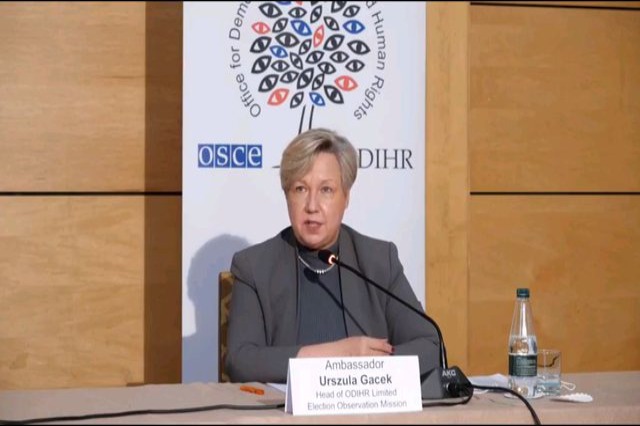
The head of the OSCE-ODIHR mission Ursula Gacek made remarks on the elections in Albania highlighting that they were transparent and calm and organized responsibly.
“The Albanian parliamentary elections were characterized by a lively and comprehensive campaign, thanks to a legal framework that helped ensure respect for fundamental freedoms. At the same time, the campaign saw authorities take advantage of public office and allegations of widespread vote buying”, international observers said in a statement today.
The Joint Observation Mission of the OSCE Office for Democratic Institutions and Human Rights (ODIHR), the OSCE Parliamentary Assembly (OSCE) and the Parliamentary Assembly of the Council of Europe (PACE) revealed that despite some ambiguities and inconsistencies, the legal framework forms a suitable basis for democratic elections. Recent changes to the legal framework provided additional safeguards and were based on a broad political consensus. The new election administration coped well with the broad new tasks it had taken on and enjoyed general confidence.
“Last year’s political agreement triggered important reforms and introduced e-technology which served to increase confidence in the electoral process. This shows that political compromise and convergence serve the best interests of the Albanian people, “said Azay Guliyev, Special Coordinator and Head of OSCE Short-Term Observers.
“I encourage all political forces to hold the same spirit in the steps following election day and to take additional action to prevent misuse of administrative resources and pressure on civil servants in future election cycles.”
About 3.5 million people registered to vote in the election, which took place against the backdrop of the global COVID-19 pandemic. While fundamental freedoms were respected, messages during the election campaign focused on party leaders rather than political platforms. The tone of language used during the campaign by some leading politicians was confrontational, and at the same time, the media did not provide essential information for voters to make their choice. The prevalence of vote buying across the country was also worrying.
“Despite the general improvements in the general framework, claims of widespread vote-buying practices throughout the electoral process remain a serious problem in Albania, and this has a negative impact on public perception and trust in the electoral process. So are the incentives and pressures exerted on civil servants, “said Aleksander Pociej, Head of the PACE delegation. “PACE and the Venice Commission are ready to continue co-operating with the Albanian authorities to further improve the legal electoral framework in the country,”he said.
“The newly introduced electronic voter identification system was installed in all polling stations. Its purpose was to reduce the risk of voter fraud, although hasty entry left no time for a public discussion or independent review of the new system. While the election day process itself was largely transparent and smooth, pandemic-related measures were poorly implemented and social distancing was not always respected.
The introduction of electronic voting technology represents a significant and welcome improvement for Albania. I was pleased to witness the large-scale effectiveness of the biometric identification system , which was used throughout the country. This is an important step that can only strengthen confidence in the electoral process,” said Reinhold Lopatka, Head of the OSCE OSCE Delegation.”
“Despite a well-developed legal framework to prevent the misuse of state resources, many public figures continued to campaign during their official capacity. This, along with the launch of several major government infrastructure projects before the election, gave the ruling party a considerable advantage. After many political conflicts in Albania in recent times, it is encouraging to see that confidence in the electoral process is slowly being rebuilt,” said Urszula Gacek, who led the ODIHR limited election observation mission.
The international election observation mission in the Albanian parliamentary elections has 125 observers from 32 countries, consisting of 42 experts and long-term observers stationed at the ODIHR, 60 parliamentarians and staff from the PA and OSCE, and 23 from the PACE.
/Klara Ruci/
Të ngjashme

Latest News
Ambassador Malaj: EU integration is a strategic goal for the continent’s security and stability



Most read










 RTI