
 English
 Français
 Deutsch
 Italiano
 Turkish
 Greek
 Serbian
Intersectoral Strategy Against Corruption 2024-2030 Presented; Pirdeni: Strengthening Prevention Mechanisms




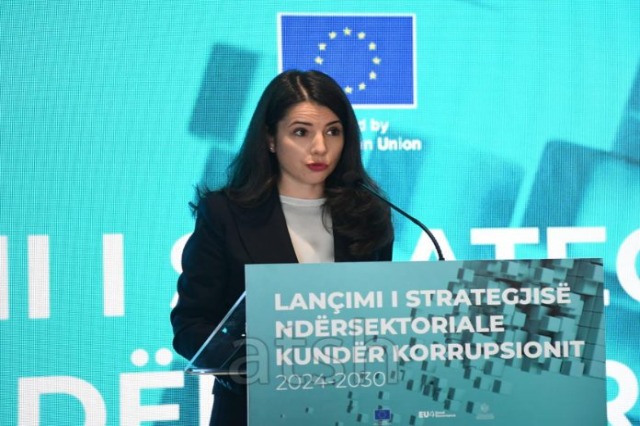
The Minister of State for Public Administration and Anti-Corruption, Adea Pirdeni, presented the ‘Intersectoral Strategy Against Corruption 2024-2030’ today, developed in collaboration with the ‘EU 4 Good Governance’project, funded by the European Union.
This strategy will serve as the foundational policy document that outlines concrete commitments from all responsible institutions to enhance the fight against corruption at all levels of governance.
As the National Coordinator Against Corruption, Minister Pirdeni stated that the aim of the Intersectoral Strategy Against Corruption 2024-2030 is to tackle the main challenges in the fight against corruption through a threefold approach focused on prevention, punishment, and awareness.
According to her, the new strategy emphasizes the implementation of a series of systemic measures designed to establish the highest standards of integrity, transparency, and accountability within public and private institutions, ultimately striving to provide efficient services to citizens.
Pirdeni highlighted that this document stresses the importance of enhancing synergy and improving effective coordination among all institutions responsible for combating corruption.
“The proposed measures are fully aligned with the national vision for Albania 2030 regarding European Union integration and address all commitments arising from the negotiation process with the EU to build stronger institutions that can increasingly resist any compromise of integrity,” she added.
The strategy identifies the most at-risk sectors that will receive heightened scrutiny for greater accountability and full transparency in their operations.
“Among these sectors are Property, Taxes and Customs, Health, Public Contracts (Procurement and Concessions), and Education,” Pirdeni noted.
She further explained that “the strategy’s implementation will be comprehensive, covering local governance, the private sector, and the strengthening of education for integrity.”
“For the first time, the strategy extends to local governance institutions and aims to promote integrity within the private sector. There is also a dedicated focus on instilling the principles of integrity and legality in young people. In this regard, the strategy aims to revise the entire pre-university education curriculum to educate youth about legality and integrity, as well as to foster close collaboration with the private sector to promote these values,” added Pirdeni.
Over the past three months, a series of open discussions aimed at ensuring the effectiveness of the Intersectoral Strategy Against Corruption 2024-2030 have been conducted with representatives from businesses, chambers of commerce, media, civil society, academia, and local self-government.
The document underwent a thorough nine-week public consultation phase, during which comments and suggestions from all stakeholders were incorporated. This process aimed to enrich the document and include diverse perspectives to comprehensively address the challenges identified by all dialogue participants.
Të ngjashme



Latest News










Most read










 RTI