
 English
 Français
  Deutsch
 Italiano
 Turkish
 Greek
Greek Serbian
Xhaçka meets the counterpart of North Macedonia: Cooperation and challenges in the region are in focus!




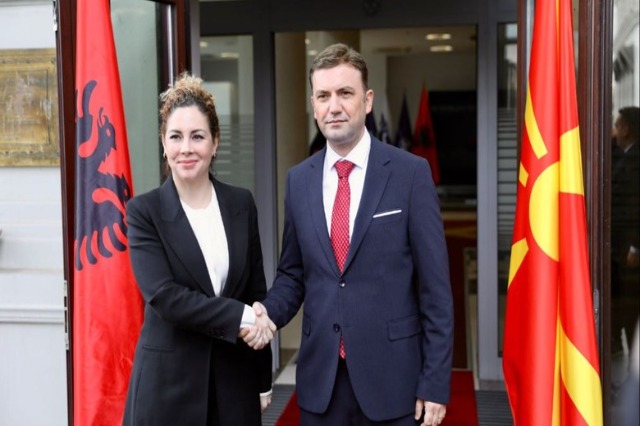
The Minister of Foreign Affairs and Europe, Olta Xhaçka, held a meeting in North Macedonia, with her counterpart Bujar Osmani. Both interlocutors held a joint conference on bilateral cooperation.
The chief diplomat emphasizes that the focus of the friendly talks between the two countries have also been the challenges of the countries of the Western Balkans after the Russian aggression in Ukraine.
“We had the opportunity to discuss, as Bujar said, the ways in which we can further intensify the cooperation between us in areas such as infrastructure, energy, commercial exchanges, tourism, education, culture, etc. With Bujar, we share a common vision for Corridor or Initiative 8, which, beyond its regional and European dimension, may also serve as the axis of cooperation and exchanges between our countries. I know that Bujar Osmani has been particularly active in promoting this initiative and I want to share with you the fact that the Albanian Government is also working on this initiative, which today, beyond the purely infrastructural and economic dimension, has also acquired an important security dimension in the context of the war in Ukraine,”said the minister.
Further, the minister also focused on the EU membership process of the two countries, citing the “uniform” journey that the two countries had to open negotiations with the union. The head of the diplomatic mission sees it as a good way for this cooperation and close diplomatic relationship to be as active, so that the road to the European Union is as easy as it is challenging.
“Today we meet as foreign ministers of two NATO member countries, but we also meet as foreign ministers of two countries that are on the verge of opening the first chapters of talks with the European Union. This puts us in front of the responsibility to deepen the reforms and to cooperate closely even in this process of primary importance, with the main goal of maintaining the momentum that this process has gained recently: the year 2022 has been historic for our two countries with the holding of the First Conference Intergovernmental, but 2022 has been a good year for the region as well, with Bosnia and Herzegovina that received the status of a candidate country or Kosovo that applied for membership and that finally, after an unfair delay, the road to visa liberalization opens,’ said Xhaçka.
The year ended with the organization of the EU-BP summit in the region, in Tirana, which was a clear signal of maintaining the EU’s focus on our region, so things are moving, there are undoubtedly difficulties and there will be many, but we must to try and work to maintain this good dynamic and our integration process to advance steadily and with concrete results.
Precisely for this purpose, I find the opportunity to encourage all political actors in North Macedonia to contribute constructively in the fulfillment of commitments that will pave the way for the progress of the country’s integration process,” she said.
As part of her visit, Xhaçka also shared with the media the conversation about Albania’s assessment of the Kosovo-Serbia agreement that was signed in Ohrid. The minister underlines that even though the document has not been signed by either party, the agreement was reached and Albania welcomes it. She also praised North Macedonia for hosting these historic negotiations.
“I shared with my colleague Osmani, our assessment regarding the Kosovo-Serbia dialogue. We welcomed the agreement reached in Ohrid on March 18 for the implementation of the annex to the agreement on the path to the normalization of relations between Kosovo and Serbia, even though the document was not signed by them. We appreciate the facilitating role of the government of North Macedonia and it is a good coincidence that the Ohrid Framework Agreement was signed in the same building 22 years ago. We believe that this agreement will contribute to strengthening stability in the Western Balkans and its Euro-Atlantic perspective and democratic institutional consolidation. We support the commitment of the EU and the USA in the implementation of the annex, which is an integral part of the agreement on the normalization of relations,” concluded Xhaçka.
/a.p/
Të ngjashme

Latest News




 RTI
RTI