
 English
 Français
  Deutsch
 Italiano
 Turkish
 Greek
Greek Serbian
Honoring the Legacy of Naum Veqilharxhi, Father of Albanian Language and Culture




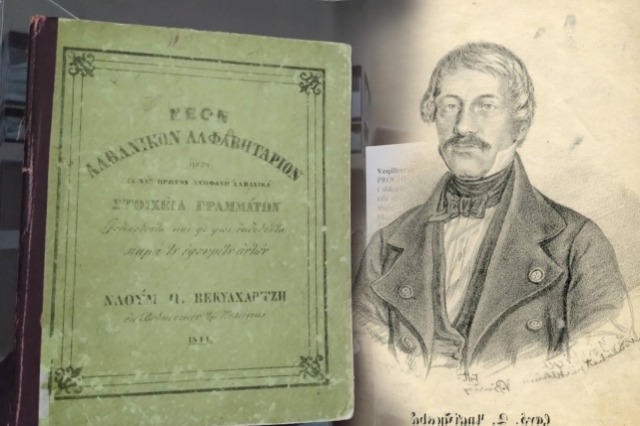
On the 227th anniversary of his birth, the National Historical Museum paid tribute to Naum Veqilharxhi (1797-1854), the first visionary of the Albanian National Renaissance.
A distinguished intellectual, illuminist, and fervent advocate for the Albanian cause, Veqilharxhi was born in Vithkuq, near Korça, before moving to Moldavia with his family. In 1821, he took part in the revolutionary movement against Ottoman oppression as one of its leaders, joining forces with other Albanians in the diaspora.
Driven by Enlightenment ideals, Veqilharxhi believed that a nation could only emerge from ignorance through the power of its native language, education, and culture. In 1824, he began work on creating a new alphabet for the Albanian language, one that would be accepted by all, transcending divisions tied to other scripts. In 1844, he published the first Albanian primer, Evëtari, which sparked widespread enthusiasm, particularly in southern Albania. The success of this book led to its reprinting in 1845, alongside a call to the youth of Albania to embrace their heritage and knowledge.
Veqilharxhi’s influence extended far beyond education—he was one of the first to recognize and warn of the dangers posed by Greek nationalist circles and the Patriarchate’s policies. He envisioned the Albanian people as a unique nation with their own language, customs, and cultural legacy, and sought to protect them from foreign influence. He championed secular schools for all children, enriching the Albanian language with new terms for culture and knowledge.
Ultimately, Veqilharxhi’s commitment to his people and his nation made him a target. Poisoned by the Patriarchate in Istanbul, he died far from home, but his impact on the Albanian Renaissance endured. Through his work, he sparked a cultural awakening, giving shape to a national consciousness that would grow stronger in the years that followed.
Naum Veqilharxhi’s legacy remains a cornerstone of Albanian history, a testament to the transformative power of language, culture, and education in the pursuit of freedom and identity.
/a.c/
Të ngjashme
Latest News


Most read









 RTI
RTI