
 English
 Français
  Deutsch
 Italiano
 Turkish
 Greek
Greek Serbian
Ndre Mjeda: Clergyman, Poet, and National Renaissance Activist




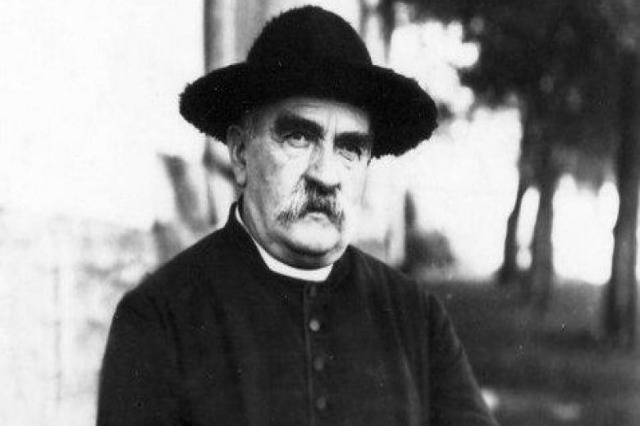
87 years ago, Ndre Mjeda passed away. Renowned as a clergyman, patriot, philologist, poet, and prominent National Renaissance activist, Mjeda was born on November 20, 1866, in Shkodër. His exceptional intellect and talent attracted the attention of Jesuits, who considered him for the priesthood.
Mjeda pursued his religious studies in Spain, Italy, and Poland. In 1883, he studied rhetoric, Latin, and Italian in Croatia. From 1884 to early 1887, he was at a college affiliated with the Gregorian University of Rome, before transferring to another Gregorian college in Chieri, Italy in 1887.
In 1908, Mjeda participated in the Congress of Manastir, which defined the modern Albanian Alphabet, with notable figures such as Father Gjergj Fishta, Luigj Gurakuqi, Hilë Mosi, and Mati Logoreci. As a representative of Shkodër, he was elected to the Commission for Drafting the Unified Alphabet of Albanian and the Albanian Literary Commission.
During the height of the democratic movement, Ndre Mjeda was involved in politics and served as a member of parliament. Following political changes in 1924, he withdrew from political life and worked as a simple priest in Kukël. From 1930, he taught Albanian language and literature at the Jesuit college in Shkodër, where he passed away on August 1, 1937.
Mjeda is celebrated as one of the greatest poets in Albanian literature. Initially inspired by romance and youthful themes, he created the poignant poem “Vaji i bylbylit” (The Lament of the Nightingale), expressing longing and personal sorrow.
He delved into the authentic life of the Albanian world with his poem “Andrra e jetës” (The Dream of Life) and explored cultural and historical roots in works like “Lissus, Scodra” (Lezha, Shkodër). His poetry reflects the transition from the romantic National Renaissance literature, focusing on patriotism, to the literature of Independence period, marked by social issues and realism. A few months before his passing, he published the powerful poetic testament “Liria” (Freedom).
Mjeda also made significant contributions to linguistics with studies in grammar and lexicology.
/a.p./
Të ngjashme
Latest News


Most read









 RTI
RTI