
 English
 Français
 Deutsch
 Italiano
 Turkish
 Greek
 Serbian
Pyramid of Tirana, bridging the gap between historical legacy and modern innovation




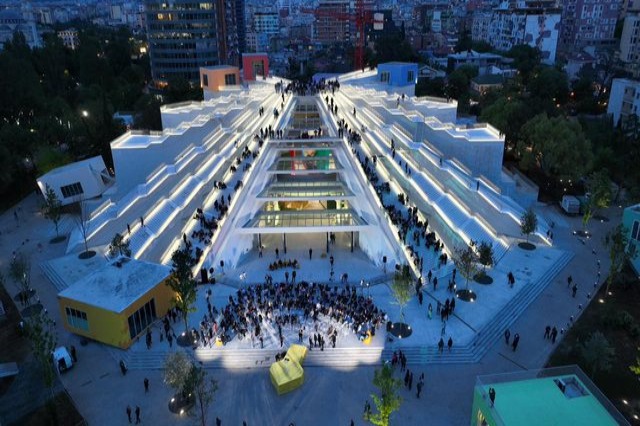
The Pyramid of Tirana is undoubtedly a symbol and a landmark of the capital, a relic of a tumultuous past and a hopeful future. Although it has been described in various ways—“majestic,” “ugly,” or “strange”—the Pyramid is an architectural object that has been extensively written about. Its controversial history has been discussed in both Albanian and international circles. However, what everyone agrees on is that the Pyramid is a reference point and a symbol of the Capital.
Built in 1988 as a museum dedicated to the former communist dictator, Enver Hoxha, it was closed three years later after the fall of communism. It was a modern work, one of the iconic projects of its time, constructed both for the dictator and for the more liberal concept he brought. The constructions of that era were dictated by the issue of value, aiming to build well and cheaply, but in this case, the authorities were generous. At a time when the economic situation was dire, around 3.5 million euros were invested, which was a significant amount for that time.
It is a concrete construction, and the structural part shows an advanced level of a social work, unique for Albania. The interior was furnished with materials imported from abroad, and every interior object was ordered from the West. The entire building was clad in marble. From a compositional standpoint, the concept was a mix between the shape of a pyramid and the concept of an eagle. It has a gradual rise towards Mount Dajti and then a descent at the back, creating an interesting symbolism for this work.
The authorities of that period paid attention to the location where it was to be built, choosing a spot right next to the main boulevard, “Martyrs of the Nation,” with an area of 28,000 square meters. From all sides, the Pyramid was meant to harmonize with the surrounding buildings, including Hotel Dajti and the Prime Minister’s Office.
In February 2021, a new project for the Pyramid was launched to ‘revitalize’ it and turn it into the largest digital center in the Balkans. The goal was to almost entirely transform it while preserving many elements of its past. In October 2023, it reopened and has since become one of the most popular spots in the Capital.
In fact, the Pyramid has changed its functional destination several times since its inception. It is crucial that the transformation it has undergone today has turned it into a reference point. Often, delegations or foreigners visiting Tirana prefer to visit it to understand what it represents. The most challenging part comes after the construction, when the building starts functioning and needs to be given the life it should have. The Pyramid is finding its own life. The main focus for us was TUMO, but this does not mean there aren’t other supportive services. We aim to make it functional 24 hours a day. The focus is on technology, but it also needs other services so that every age group can find its place here.
Currently, the Pyramid serves as a center for creative technologies TUMO, a company that offers a new, free educational experience. Approximately 1,500 young people aged 12 to 18 are provided with the development of their digital skills in 10 different disciplines, gaining a secure profession for the future.
Numerous international media have dedicated articles to the Pyramid of Tirana. In various articles, it is rated as one of the top 12 architectural projects in the world, and the Tirana Municipality’s initiative to transform what was once Hoxha’s museum into the largest technological center in the Balkans is highlighted. Every day, the Pyramid attracts many local and foreign visitors. In the tours offered by agencies, the Pyramid is one of the most important destinations where stops are made and information is provided about it.
/k.s/
Të ngjashme




Latest News










Most read










 RTI