
 English
 Français
  Deutsch
 Italiano
 Turkish
 Greek
Greek Serbian
Idriz Seferi: “I just cannot turn my back on this people”




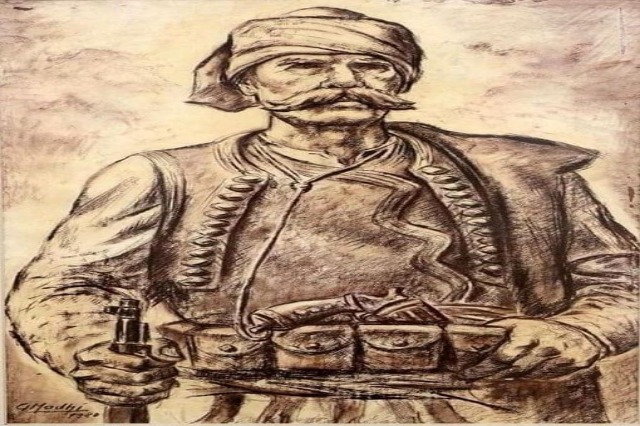
The end of the 19th century and the beginning of the 20th century, in the history of the Albanian people, is considered as its most turbulent and sensational period. It was a period of continuous uprisings that, in essence, were just the continuation of centuries-old wars against continuous oppression for freedom and independence, which finally enabled the declaration of the independent Albanian state (on November 28, 1912). In these wartime circumstances, he grew up and was molded with high patriotic ideals and developed his patriotism, the son of the highlands, Idriz Seferi.
The personality of Idriz Seferi is ranked among the fighters, who became known as early as the Albanian League of Prizren, while his presence on the fronts of the war against the centuries-old Ottoman conqueror, as well as in the Assembly of the Covenant of the time, lasted up to his biological death.
According to the not so complete data in the history texts of the Albanian people, Idriz Seferi was born in 1847 in the village of Sefer, near Shkup/Skopje. He was a member of a large highland family, known for faith, bravery and patriotism. From a young age, he stands out for his stance against the Ottoman rule, this rule which had reduced all the Albanian lands to scarcity, misery and poverty. In 1875 he was imprisoned by the Ottoman authorities. Three years later, with a group of highlanders from Karadak and the province of Gjilan, he participated in the Albanian League of Prizren in 1878, headed by Avdyl Frashri, Ymer Prizreni, Sulejman Vokshi and many other patriots from all parts of Albania, in the fight and struggle to preserve and make independent the Albanian lands, with which the Porte was trading, after every loss and defeat on the Eastern fronts with Russia.
Like all freedom-loving Albanians, even Idriz Seferi and his brave men had set out on the road to help the nation, the people of language and blood. Idriz Seferi belongs to the era of Albanian leaders, in the fight for liberation from centuries-old Ottoman rule.
Battle of Kaçanik, the Albanian Thermopylae of the time
On April 30, 1910, the Ottoman army, commanded by Shefqet Turgut Pasha and initially consisting of 9,000-10,000 men, reinforced with cavalry units and supported by artillery fire, began the attack against 3,000-4,000 Albanian insurgents of centered on the Kaçanik Gorge, led by Idriz Seferi. Before the general attack, the Ottoman army hit the surrounding villages with artillery. The massacre of the women, children and elders who had remained there did not, as Shefqet Turgut Pasha had predicted, discourage the Albanian defenders of the Kaçanik Gorge. On the contrary, despite the great numerical superiority of the enemy forces, the insurgents broke their attacks. For two consecutive days (April 30-May 1) the Ottoman division could not overcome the resistance of the Albanian insurgents, who showed special fighting skills.
The Ottoman forces directly involved in fighting against the insurgents in Kosova amounted to nearly 30,000 people. A large part of them were engaged in the battle of Kaçanik. Although the Turkish army had a significant advantage over the insurgent forces, they withstood their attacks for seven consecutive hours, even going into hand-to-hand combat. The leaders of the uprising showed leadership skills in attack, defense and retreat. They were able to get out of the siege in an organized manner and, retreating towards Gjilan, continued to hit the enemy.
In the battle of Kaçanik, the Ottoman army suffered heavy losses. According to various reports, several thousand soldiers and 90 Ottoman officers were killed. Shefqet Turgut Pasha lost more than a quarter of the forces under his command at Kaçanik, about 20 battalions were destroyed. After that the army began to take revenge on the defenseless population. Special units of the Turkish army burned the villages that the artillery had failed to raze. The extraordinary military trial convicted the captured insurgents and their supporters. The execution of those sentenced to death took place in front of the local population gathered by force and to the sound of drums and marches of the military band.
The battles that the Albanian insurgents fought in Kaçanik had echoes inside and outside the country. They were immortalized in the folk epic.
/a.p./
Të ngjashme
Latest News





Most read







 RTI
RTI