
 English
 Français
  Deutsch
 Italiano
 Turkish
 Greek
Greek Serbian
In memoriam of the prominent Arber poet Gavril Dara i Riu




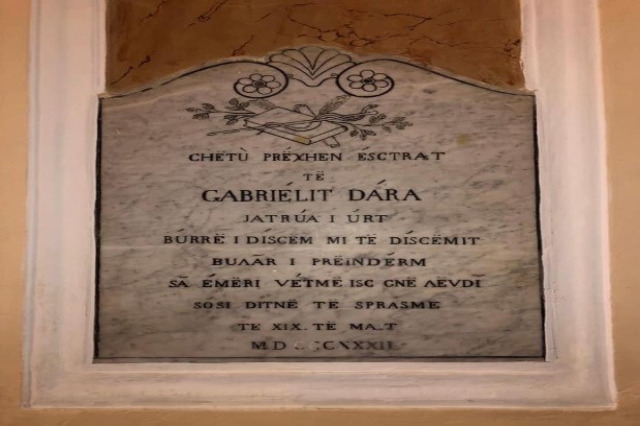
On January 8, 1826, Gavril Dara i Riu (Junior) was born, in Palazzo Adriano, an Albanian town in Sicily, southern Italy. He was raised in a Byzantine family deeply involved in literature. His grandfather, Gabriele Dara Senior, was among the initial collectors of Arbëresh folklore, while his father, Andrea (Ndre), authored a dictionary of Albanian folklore terms.
Dara i Riu was recognized as the most prominent Arber poet after De Rada, and he became an integral part of the literary movement of his time, following in his father’s footsteps. He was an Italian poet and politician of Sicilian Albanian descent. He actively participated in the national movement and contributed to serving the motherland through his pen. Similar to De Rada, he chose the glorious past of the Albanian people as the central theme of his work.
At a young age, he acquired proficiency in Latin and ancient Greek. He received his initial education at the Arber seminary in Palermo, where he also pursued his higher studies in law. Following the unification of Italy, he held various governmental positions in Sicily. Initially, he served as the first councilor of the prefecture of Palermo.
Subsequently, from 1867 to 1869, he held the position of governor of Trapani, a city located in western Sicily. In 1858, he founded and published the literary newspaper “Renewal of Life” (Palingenesi). Later, between 1871 and 1874, he served as the director of the liberal political magazine La Riforma.
Distinguished in the realm of revolution, he was appointed by Garibaldi as a general advisor to the government in Agrigento. After concluding his political career, which encompassed various positions, he redirected his focus toward literature.
After concluding his political career, which encompassed various positions, he redirected his focus toward literature. His most renowned work, a poem resembling the chivalric genre but infused with strong influences from Sicilian folklore of his era and Romanticism in general. Dara left behind a manuscript considered one of the most accomplished works in our literature, titled “Kënga e sprasme e Balë” (“The Wise Song of Balë”). This publication stands as the sole remaining Albanian work from his creative endeavors.

His early literary works encompassed verses in Italian and a poem in Albanian dedicated to Saint Lazarus. However, Dara’s most renowned piece is “Kënka e sprasme e Balës” (Bala’s Last Song), initially composed in the Albanian language and subsequently translated into Italian. This epic romantic ballad, divided into four parts comprising nine cantos, narrates the adventures of Nik Peta and Pal Golemi, two Albanian heroes who lived during the era of the League of Alexios. Initially serialized after his death, it was first published in 1887 in the periodical “Arbri i ri” (Young Albania), edited by Giuseppe Schirò. Subsequently, in July 1900, the work was published in its entirety in both Albanian and Italian in the magazine “La Nazione Albanese.”
Dara passed away in Girgeti on November 15, 1895.
/m.ll/
Të ngjashme
Latest News



Most read








 RTI
RTI