
 English
 Français
  Deutsch
 Italiano
 Turkish
 Greek
Greek Serbian
Elena Gjika – Dora D’Istria: “I hope we will live until that day when the flag of Skanderbeg will be raised above the towers of Rozafa”




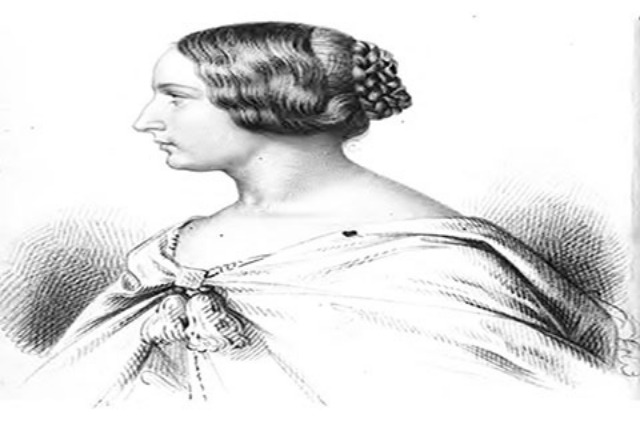
Elena Gjika (Dora D’Istria) was born in Bucharest in 1828 to Albanian parents. The daughter of Mihal Gjika, the brother of Prince of Wallachia Grigor Gjika and Katarina, Elena Gjika received an excellent education, studying literature first in Dresden, Germany, then in Vienna, Italy and finally in Berlin where she graduated in ancient Greek literature.
She lived in Romania, Russia, Switzerland, France, Greece, Turkey and Italy. She is the first woman to climb Europe’s highest peak “Mont Blanc” in 1860. One of the most elevated and intelligent women of her time, Elena became known almost throughout Europe as a writer, feminist activist, composer, painter and researcher. A member of many scholar societies, such as the Italian Academy, etc., she was also named an honorary citizen by the Greek parliament and many Italian cities.
She wrote under the name Dora D’Istria, She was revolutionary, insurgent, with many political and social ideas that preceded her time. She maintained regular correspondence with the outstanding Arbëresh of Italy, Jeronim De Rada and Giuseppe Garibaldi too. She is probably the first intellectual personality who proposed the idea of a Balkan federation where all the countries of the Balkans would join.
Princess Elena Gjika was affirmed as a writer, publicist and scientist at the world level. She published her writings in 6 European languages. It became especially popular with the work “Femeile in Oriente” (“Women of the Orient”, Paris, 1860), which was followed by the work in German “La Suisse allemande”, Geneva 1856, a description of Switzerland and its people, in part of which describes the ascent of Mount Monk. In the writing “Les femmes en Orient” (Women in the Orient, Zurich 1859, 2 Volumes) and “Des femmes, par une femme” she wrote about the emancipation of women. She also published the story “Au bord des lacs helvétiques” /Voyage on the Swiss Lakes/, Geneva, 1861 and “Ekskursions en Rouméllie et en Moree” (Excursions in Rumelia and More, Zurich 1863, 2 Volumes).
Elena actively participated in the progressive cultural movement of Europe and supported the Albanian National Renaissance, maintaining close ties with its prominent activists, such as: Jeronim de Rada, Dhimitër Kamarda, Zef Jubani, Zef Serembe, Thimi Mitko, etc. In a series of studies: /Albanian nationality according to popular songs/ “La nationalité albanaise d’après les chants populaires”, 1866, “Les ecrivains albanais de l’Italie Méridionale” /Albanian writers of Southern Italy, 1867/, “Gli albanesi in Romania” /Albanians in Romania, 1873/ etc., she pointed out through historical folk songs the centuries-old struggle of the Albanian people for freedom. As a sign of gratitude for the help given in the recognition of the Albanian issue by the world public opinion, the Albanian National Renaissance activists and Arbëresh patriots of Italy and Greece dedicated the book entitled: “A Dora D’Istria – Gli Albanesi” (Dora d’Istrias-Albanians, 1870), a collection of patriotic poems.
She met also with the US poet Longfellow who wrote a poem on George Kastrioti Skanderbeg. “He promised me that I will soon write a poem about Skanderbeg”, writes Dora D’Istria, adding his promise, which was: ” As soon as I have written it, I will send it to you”.
Eager for the freedom of Albania, Elena Gjika, in the last years of her life, wrote: “I hope we will live until that day when the flag of Skanderbeg will be raised above the towers of Rozafa” (Shkodër Castle).
At the age of 60, on November 17, 1888, she passed away, at a time when the Albanian National Movement went from a cultural movement to an armed movement.
/a.p./
Të ngjashme
Latest News
Most read








 RTI
RTI