
 English
 Français
  Deutsch
 Italiano
 Turkish
 Greek
Greek Serbian
Franciscan cleric Shtjefën Gjeçovi, an Albanian patriot and a diligent researcher




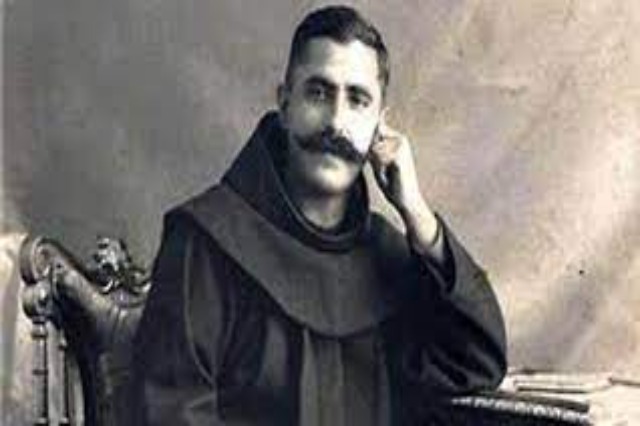
On July 25, 1896, the Franciscan cleric Shtjefën Gjeçovi was ordained a priest in a village near Klina.
Gjeçovi was born on 12 July 1874 (some sources mention 3 October 1873 in Janjevo, Prizren Vilayet, Ottoman Empire (now Kosovo). He was educated by the Franciscans in Bosnia (under control of Austria-Hungary) and moved to Ottoman Albania in 1896, having become a priest, and spent the years between 1905 and 1920 among the Albanian highland tribes, collecting oral literature, tribal law, archaeology and folklore. Gjeçovi was also an important collector of the Albanian Songs of the Frontier Warriors.
An Albanian patriot and a diligent researcher on everything related to the Albanian past, he was loathed by the Serbian population and the local authorities. He was shot on 14 October 1929, in the village of Zjum near Djakovica (at the time part of Yugoslavia) while serving as the local priest and teacher by a Serbian nationalist. Several schools in Kosovo and Albania bear his name.”Traces of Gjeçovi”, is a yearly event held in his birthplace Janjevo since 2000, to memorialize and promote his work and legacy.[Gjeçovi collected and wrote Kanuni i Lekë Dukagjinit, a set of traditional Albanian customary laws that was published in 1933. Although researchers of history and customs of Albania usually refer to Gjeçovi’s text of the Kanun as the only existing version which is uncontested and written by Lekë Dukagjini, it was actually incorrect. The text of the Kanun, often contested and with many different interpretations, was only named after Dukagjini. The customary laws were not static in period between 15th and 20th century and one of the main reasons for Gjeçovi’s work on the Kanun was to adapt it to correspond with the changes in the society of Albania.
/k.s/
Të ngjashme
Latest News




Most read









 RTI
RTI