
 English
 Français
  Deutsch
 Italiano
 Turkish
 Greek
Greek Serbian
102nd birth anniversary of Albanian painter Guri Madhi




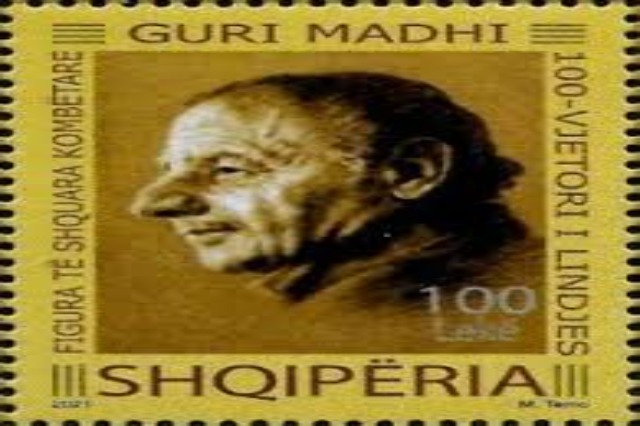
Guri Madhi was an Albanian outstanding painter, founder of the Academy of Arts in 1960.
He was born on May 15, 1921 in Korça. After finishing primary school, Guri Madhi attended the Italian high school in Korça for two years, which was based on drawing. After the second year, this school was closed and he was forced to stop further education and for family needs to start working in the cinemas of his city.
During the war years (December 1939 – May 4, 1942) he became a soldier in the Italian army, in the Tarabosh battalion. After returning from military service in Korça, he continued to work and at the same time help the anti-fascist movement. After the war, he started working as a house painter of culture and then as an assistant set designer at the Korça Theater, where one of the most famous Albanian painters of that period, Vangjush Mio, worked as a set designer. He completed his painting studies in the Soviet Union. Since 1950, he began his studies at the Academy of Arts in Leningrad (Saint Petersburg) where he received his Diploma in 1956 and completed his higher education with excellent results.Then he would return to Albania, where he would take up the post of inspector at the Ministry of Culture in Tirana.
In 1958, he was appointed a teacher at Jordan Misja Artistic High School in Tirana. In 1961, he is one of the three lecturers who founded the High Institute of Fine Arts (today the Academy of Arts) in Albania. The year 1966 would be characterized by the war against the bureaucracy, as a result of which Guri Madhi was sent to the garrison of Grehoti in Gjirokaster, where he was expelled from the ALP in 1967. During this period he left Gjirokastra and stayed for more than a year unemployed. He starts work in the teaching tools company in Tirana and then he is given a creative license for a period of two years, to realize the painting “Agrarian Reform”. For many years he has been engaged in teaching at the artistic high school Jordan Misja and at the Academy of Fine Arts. In 1983 he retired and at that time he was one of the most popular painters of his generation.
Guri Madhi has also been active in his hometown as an actor. He had a leading role in the play “Under the Chestnuts of Prague” by Konstantin Michailoëitsch Simonov, in Moliere’s “Copraci”, etc.
In his early periods Guri Madhi paints episodes from the history of Albania and from the current circumstances. He was given many tasks and orders from the regime to show socialist realism in works. But in the last years of his life he dedicated himself to a free art. His activity of the years 1955-1988 counts about 400 paintings.


Art critics distinguish 3 periods in his artistic journey:
· The period after studies with impressionist influences
· A brief period 1965-66 with surrealist influences
· The period after 1980, until 1988, with expressionist and abstract painting
His 1956 diploma subject “Bajram Curri in Dragobise Cave” shows the National Hero Bajram Curri in the style typical of the Russian Impressionists.
Of great value to mention is the realization of the work “Meeting of 81 parties in Moscow, 1960”, which is one of the most important works of socialist realism in Albania. He has composed in the painting with dimensions 265 x 210 cm, the opposite attitude of the Party of Work of Albania to the rest of the leaders and communist parties at a conference in Moscow in 1960.
Despite the fact that the origin of Guri Madhi was Korça, he dedicated many of his works to the subject of Kosova. He even related his diploma topic to this province. In the years after his return to Albania, he traveled to the border areas with Kosovo (the borders with Yugoslavia had been closed since 1948). He has painted many portraits of Kosovars in characteristic costumes. In 1978, he had the opportunity to work for 2 weeks in Kosovo. At this time many of his graphics are published in the local press. In 1979, his exhibition was opened in collaboration with the painter Kujtim Buza with the title “Through historical places of Kosova”. In 1981 joint exhibitions are again organized in Prishtina, Ferizaj and Prizren. Some of his works can be found in Kosova, one of which has been donated to the Art Gallery of Kosova.
For many years, Madhi had to submit to the rules set by the regime. He worked on orders and had to retouch personal works as well. Nude women should have their clothes painted over. Towards the last years of his life, he moved away from the strict rules more and more. Even when he could not show his works in exhibitions, he was able to paint according to his desires and inspiration.
In 2011, 23 years after the death of Guri Madhi, his family found during a routine arrangement of the works, some hidden paintings which, if discovered during communism, would have sentenced the painter to prison. He painted on both sides of sheets or cardboard, thus leaving visible only one side, the side which conformed to the rules of socialist realism.
Guri Madhi is the only Albanian artist who was expelled from the communist party and later in 1976 he was honored anyway with the title People’s Painter.He dies in 1988 in Budapest.
/k.s/
Të ngjashme
Latest News
Most read








 RTI
RTI