
 English
 Français
  Deutsch
 Italiano
 Turkish
 Greek
Greek Serbian
George Kastrioti Scanderbeg, National Hero of Albanians was born on May 6, 1405




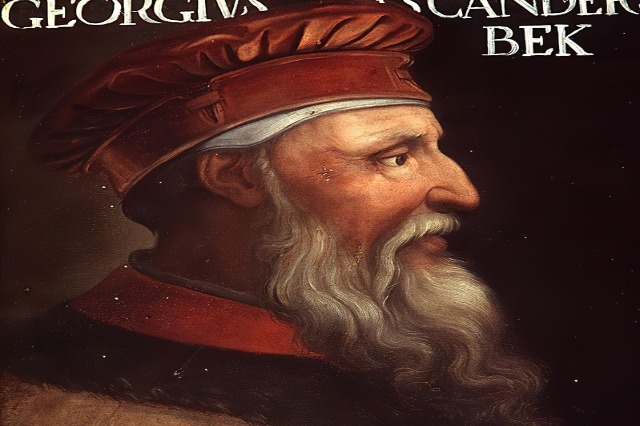
George Kastrioti Skanderbeg was born on May 6, 1405. His figure represents one of those cases, not frequent in history, when the different social strata of a nation meet with an outstanding personality, in which their best aspirations and qualities find their expression and which therefore it becomes a symbol of national unity and their common struggle.
Gjergj Kastrioti Skanderbeg remains the most consistent and prominent representative of the Albanian leadership elite, who resolutely led the front of the Albanian war against the Ottoman invaders. He understood, more clearly than anyone else, the task posed by the historical moment: The need for political union as the main condition to realize the protection of the interests of all social strata, rich and poor, already threatened by the Ottoman invaders in vital matters.
The deep knowledge of the life, the world view, the tradition and the struggle of the Albanians against the foreign invasion as well as the organization of the state and the Ottoman army, gave Skanderbeg the opportunity to build with high effectiveness all his activity as an outstanding statesman and army commander. He came to the conclusion that, in the face of a powerful conqueror, such as the Ottoman Empire, the Albanians could not achieve victory without overcoming the political fragmentation of the country into a series of possessions, without a stable organizational base, without the coordination of means and resources, human, economic, military and material, without the coordination of all the actions that took place at the internal level and these with the actions undertaken at the international level. One of the first steps in this direction was the establishment, on his initiative and under his leadership, of the Albanian Covenant of Lezha, which was the first broad political union of Albanians.
Knowing the development of events and their perspective, Skanderbeg understood in time that it was not possible to defend the country, to liberate the occupied territories and to finally eradicate the risk of the Ottoman invasion, standing on the basis of the Albanian Covenant as a voluntary political alliance, a characteristic that it had had it in its beginnings. Therefore, within the coalition of Albanian nobles, a shift in the balance of forces was carried out hand in hand (which characterizes the second stage of Skanderbeg’s activity as a statesman), and which led to the creation of a single state power. He became the founder of the independent Albanian state.
The spiritual union of the entire Albanian people and the strengthening of their national consciousness marked the greatest victory of the glorious epic of the century XV and the entire deed of Skanderbeg.
Skanderbeg’s skills as a statesman also stood out in relations with other countries. He rightly assessed the importance of international cooperation, as a necessary condition to face the Ottoman aggression. Skanderbeg turned to the European countries and asked for their participation in the fight against the common enemy, and material support for the fight of the Albanian people.
Skanderbeg’s personality as a statesman is inseparable from his activity as a talented military leader. In the conditions of inequality, Skanderbeg worked out his military strategy and tactics, based on which was the opinion that victory could not depend on the number of soldiers. This principle, followed by him, is also expressed truthfully by the words that Barleti (his contemporary historian) put in Skanderbeg’s mouth, that “who is not able to defeat the enemy with an army of 8 to 12 thousand people, would not be able to do this even with a much larger army”.
Skanderbeg relied on a lightly armed army, with great mobility and high striking ability, formed mainly by volunteers who had combat readiness and selfless spirit. Even he himself fought unencumbered with heavy weapons and with an outstretched arm like an ordinary soldier. In battle he was, at the same time, a talented commander and a brave soldier, who with his example became a source of inspiration for Albanian warriors.
The memory of Skanderbeg lived not only in the heart of the people who gave birth to him. It had an extension that crossed the borders of the Balkan Peninsula, it had a European importance. Skanderbeg forced them to talk about him all the time.
Anytime when the Ottoman invasion stood like a sword over Central Europe, or when national liberation movements would break anywhere in Europe, Balkan Peninsula, or elsewhere, historians, writers and poets used the figure of the Albanian Hero as an inspiring banner for mobilizing their people in the fight for freedom. Permanent evidence of the appreciation and deep respect that other peoples have for Skanderbeg, in addition to numerous publications about him, are the squares and streets of Rome, Paris, Brussels, Geneva and other cities of different countries, where there are monuments and busts of him or that bear the name “Georg Kastrioti – Skanderbeg”.
/a.p./
Të ngjashme
Latest News
Most read






 RTI
RTI