
 English
 Français
  Deutsch
 Italiano
 Turkish
 Greek
Greek Serbian
Albanian poet, linguist, esthete, essayist, folklorist and publicist Jeronim De Rada




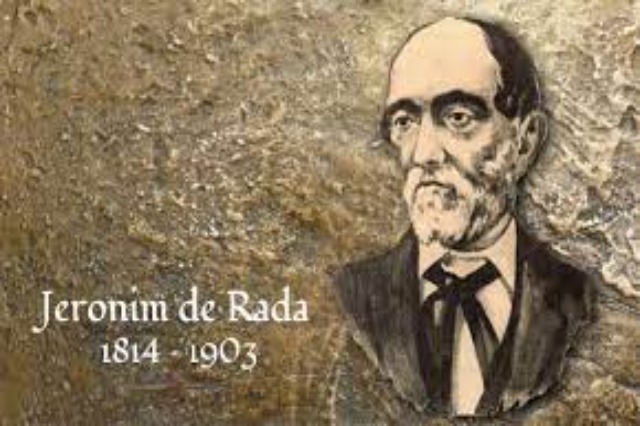
Today is the 120th death anniversary of the Albanian poet, linguist, esthete, essayist, folklorist and publicist Jeronim De Rada.
Rada, the most well-known writer of Albanian literature, once the most prominent figure of the Albanian national movement was born on November 29, 1814. He attended the College of Saint Adrian in Saint Miter. He graduated from the Faculty of Law of the University of Naples, but his main interest remained folklore and literature. In Naples, in 1836, he published the first edition of his best-known Albanian poem, Songs of Milosao. In 1848 he published the first Albanian newspaper “L’Albanese d’Italia”. This bilingual, political, literary newspaper, with a circulation of 3,200 copies, was the first periodical in the Albanian language that was published anywhere. De Rada played a major role in the history of Albanian literature; he is the first to write works with a national spirit. In 1883, De Rada founded the bilingual monthly magazine Fiamuri Arbërit – periodical, which, despite Turkish and Greek censorship, was widely read by Albanians in the Balkans. De Rada was the first genius of the Albanian National Renaissance. De Rada, the great poet and “prophet of the future”, returned Albanian literature to the European orientation.
De Rada’s writings in Italian precede those in Arabic. But these creations, which are prose translations of Arbëresh poems, are distinguished from Italian poems according to Pipa. His interest in folklore was pushed by the reading of the theorist of Romanticism, Schlegel, from where his devotion to the arberesh language started and he came out of the Italian phase of the influences of Dante, Ariosto and Foscolo.The works in poetry, except “Odisse” (which De Rada called “with an Arberian theme”) and “Sofonisba”, are all in Arabic, but provided with an Italian prose translation alongside the original. The titles of works in poetry, usually long, are in Italian with one exception: Skanderbek i Pafaan. Other works are in Italian. While from the two periodicals edited and published by De Rada, L’Albanese d’Italia is also in Italian, while Fiamuri i Arbëri is in both languages.
Folklore
Hired by the Calabrian lawyer Rafaele Valentini, in September-October 1833, the then nineteen-year-old De Rada began to collect Arberian folk songs in the Calabrian-Arberian villages of the province of Cosenza. In the fall of 1834, he wrote “Raccolta di canti albanesi”, and in 1866 he published “Rapsodie” under the supervision of N. Tommaseo. In 1845 Kamarda showed him a bunch of popular songs collected by F. Avati.
In 1963 or 1964 Giuseppe Ferrari published a manuscript of De Rada, which he called Canti albanesi. Raccolda di Michele Bellusci del ‘600 found in Frashinete. A work that has 11 songs in common with Milosao and Ferrari’s thesis led to a charge of plagiarism. In 1966 Francesco Solano in an article published in “Shejzat” rejected Ferrari’s hypothesis, proving that the language used was that of De Rada’s sides, but also the style was very similar to Milosao’s style. Solano concluded that the collection of songs collected by Belushi was none other than the first collection of folk songs collected by the De Rada boy at the instigation of Valentine.
Poems
In 1832 he wrote Odisse in terza rima. In 1833, having just finished his studies at the college of St. Adrian, he was assigned to manage the family’s property, and it happened that he got to know the daughter of the farmer who dealt with the cattle herd of the De Rada family. It didn’t take long and the young poet began to write love poems in the style of popular songs he collected at the time, “imitating as much as he could the simplicity of rhapsody”. The following year, on January 6, 1834, the day of the Epiphany, he composed the first idyll in which a love episode is presented that later appeared in Milosao. In the years 1835-1836 he began to write the first sketch-ideas of Proto-Milosao and Proto-Serafina. On February 22, 1836 he published for the first time in Omnibus “Canto in morte di Scanderbeg”. In 1837 he sketched different songs of Scanderbeg and wrote the first version of Serafina, which he printed in 1839. Pipa thinks that Skanderbeg is a continuation of Serafina with a different name.
During his one-month imprisonment, he wrote a poem dedicated to Huniad, Giovanni Uniade, published posthumously. In 1841-42 he wrote the tragedy I Numidi, which did not warm his friends that much, which he published in 1846. He tried his luck with the philosophical treatise “Divinazione pelasgiche”, published first in Lucifero and then in Mattneer in 1842. In 1861 he published “Principi di estetica”, “Antichità della nazione albanese”, “Lettera a Stamile”, takes care of the grammar that his son Giuseppe worked on “Grammatica della lingua albanese” based on the dialect of Krati, in 1870. In 1890 he published ” Pelasgi ed albanesi”, 1892 “Il Collegio Albanese”, “La Cattedra Albanese” and wrote the tragedy “Sofonisba”. In 1894 he wrote the work “Caratteri e grammatica”, in 1896 “Abecedario” and “Antologia”, in the years 1898-1902 “Autobiography” and “Testamento politico”.
De Rada also organized two linguistic congresses on the issue of Albanian (Koriljano Kalabro, 1895, Hungary, 1897), participated in the XII Congress of Orientalists in Rome, where he spoke about our language and, with his efforts, a chair of Albanian was established in Institute of Oriental Languages in Naples.
In this period he was again an Albanian teacher in Saint-Adrian. Jeronim De Rada passed away on February 28, 1903 .
Të ngjashme


Latest News










Most read









 RTI
RTI