
 English
 Français
  Deutsch
 Italiano
 Turkish
 Greek
Greek Serbian
National Historical Museum commemorated today on the 176th anniversary of the birth of the poet and writer Naim Frashëri




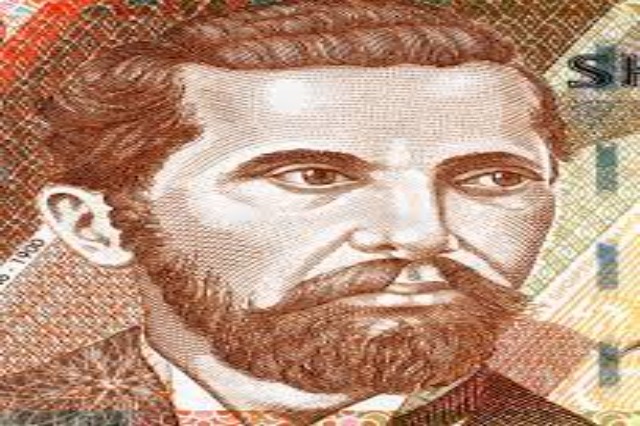
The National Historical Museum commemorated today on the 176th anniversary of the birth of the poet and writer Naim Frashëri (1846-1900).
Naim Bey Frashëri, more commonly Naim Frashëri was an Albanian patriot, historian, journalist, poet, rilindas and translator who was proclaimed national poet of Albania. He is regarded as the pioneer of modern Albanian literature and one of the most influential Albanian cultural icons of the 19th century.
Naim and his brothers Abdyl and Sami were born and raised in the village of Frashër at the southern slopes of the Tomorr Mountains. He became acquainted with numerous cultures and languages such as Arabic, Ancient and Modern Greek, French, Italian, Ottoman Turkish and Persian. He was one of the few men to whom the literary culture of the Occident and Orient was equally familiar and valuable.
Frashëri’s masterpieces explored themes such as freedom, humanity, unity, tolerance and revolution. His extant works include twenty two works composed of fifteen works written in Albanian as well as four in Turkish, two in Greek and one in Persian, accessible to an audience beyond Albania. He is the most representative writer of sufi poetry in Albanian, being under the influence of his uncle Dalip Frashëri, he tried to mingle sufism with western philosophy in his poetical ideals. He had an extraordinarily profound impact on the Albanian literature and society during the 20th century most notably on Asdreni, Gjergj Fishta and Lasgush Poradeci, among many others.
His religion paved the way for much of his future accomplishments. In the Tekke of Frashër, he received lessons in all the common subjects of his time especially in languages such as Arabic, Ottoman Turkish and Persian. As a member of a family which gave him a strong Bektashi upbringing, he spent a part of his time in a Bektashi tekke. After the death of their parents, the family moved to Ioannina in 1865. The eldest brother, Abdyl (b. 1839), became the family head at the age of 22 and started working as a merchant. That year Naim and Sami enrolled in the Zosimaia secondary school.The education there provided Naim with the basics of a classical education along Western lines. Apart from languages he learned in the Zosiamaia, Naim took private lessons in Persian, Turkish and Arabic from two important local Bektashi.
After he finished his studies in 1870, Frashëri worked for a few months at the press office in Istanbul (1870) but was forced to return to his home village because of tuberculosis. The climate of Frashër helped Naim and soon he started work in the Ottoman bureaucracy as a clerk in Berat and later in Saranda (1872–1877).However, in 1876 Frashëri left the job and went to Baden, in modern Austria to cure his problems with rheumatism in a health resort.
The prime representative of Romanticism in Albanian literature, Frashëri is considered by many to be the most distinguished Albanian poet of the Albanian Renaissance whose poetry continued to have a tremendous influence on the literature and society of the Albanian people in the 20th century. He is also widely regarded as the national poet of Albania and is celebrated as such among the Albanian people in Kosovo, Montenegro, North Macedonia and other Albanian-inhabited lands in the Balkans.
After his death, Frashëri became a great source of inspiration and a guiding light for the Albanian writers and intellectuals of the 20th century amongst them Asdreni, Gjergj Fishta, Mitrush Kuteli and Lasgush Poradeci. His great work such as Bagëti e Bujqësi, Gjuha Jonë and Feja promoted national unity, consciousness, and tolerance in the breasts of his countrymen an enthusiasm for the culture and history of their ancestors.
Albanians of the Bektashi faith were in particular influenced and motivated by his work.Himself a Bektashi, he desired purity of the Albanian language and had attempted in his lifetime to Albanianise hierarchical terms of the order in his work Fletore e Bektashinjët which called for an Albanian Bektashism.
Numerous organizations, monuments, schools, and streets had been founded and dedicated to his memory throughout Albania, Kosovo as well as to a lesser extent in North Macedonia and Romania. His family’s house, where he was born and raised, in Frashër of Gjirokastër County is today a museum and was declared a monument of important cultural heritage. It houses numerous artefacts including handwritten manuscripts, portraits, clothing and the busts of him and his brothers Abdyl and Sami.
Frashëri’s portrait is depicted on the obverses of the 500 lekë banknote from 1992 to 1996 and since 1996 on the 200 lekë banknote. On the reverse side of the bill is a picture of his family house in Frashër. The Albanian nation has established an order of merit that bears his name which was awarded to, amongst others, the Albanian nun and missionary Mother Teresa.
In 1900 Naim Frashëri died in Istanbul. During the 1950s the Turkish government allowed for his remains to be sent and reburied in Albania.
Oh Mountains of Albania
“Oh mountains of Albania
and you, oh trees so lofty,
Broad plains with all your flowers,
day and night I contemplate you,
You highlands so exquisite,
and you streams and rivers sparkling,
Oh peaks and promontories,
and you slopes, cliffs, verdant forests,
Of the herds and flocks
I’ll sing out which you hold
and which you nourish.
Oh you blessed, sacred places,
you inspire and delight me!
You, Albania, give me honour,
and you name me as Albanian,
And my heart you have replenished
both with ardour and desire.
Albania! Oh my mother!
Though in exile I am longing,
My heart has ne’er forgotten
all the love you’ve given to me …”
Të ngjashme
Latest News
Most read





 RTI
RTI