
 English
 Français
 Deutsch
 Italiano
 Turkish
 Greek
 Serbian
Sydney Morning Herald: Gjirokastra, the quaint European town that belongs to a dream




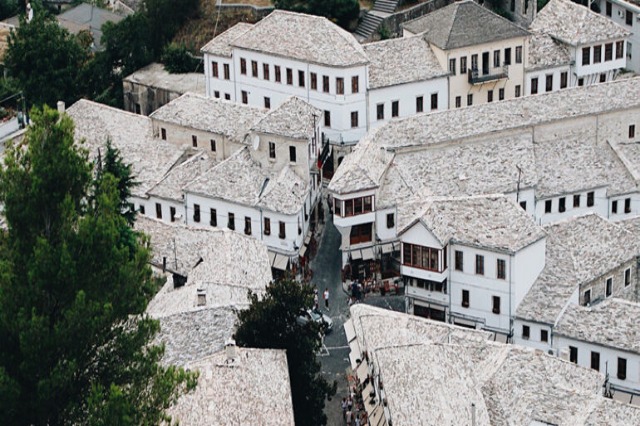
At the height of the season Gjirokastra and Saranda are populated by Italian and British tourists – who are attracted by the relatively cheap lifestyle, crystal clear waters and hot Mediterranean weather, writes Keith Austin in an article published in the Australian daily “The Sydney Morning”. Herald”.
Ismail Kadare, who died this week aged 88, may be the most famous writer no one has ever heard of outside the literary world. He wrote 80 novels, plays, screenplays, poems, essays and short story collections and his works have been published in 45 languages.
In 2005 he received the inaugural Man Booker International Prize and was nominated for the Nobel Prize in Literature 15 times.
Ismail Kadare has been compared with Kafka and Orwell, with Gabriel Garcia Marquez, Milan Kundera and Balzac. In his native Albania, he often found himself at odds with the one-party communist regime of former dictator Enver Hoxha, who ruled the country from 1946 until his death in 1985.
Kadareja and Hoxha might have been poles apart politically and morally, but they had one thing in common: they were both born in the medieval town of Gjirokastra, in the south of the country.
Hoxha’s house is no longer there. It burned down in the early 1960s and is now the site of the Ethnographic Museum, but Kadareja bequeathed his old home to the nation and is now a museum dedicated to the man, his life and works.

The nearest major city to Gjirokastra is Saranda, a port and coastal resort town on the Albanian Riviera, as the region is increasingly described.
“In peak season Gjirokastra and the coastal town of Saranda are populated by Italian, British tourists – attracted by the relatively cheap lifestyle, crystal clear waters and hot Mediterranean weather.”
A small number of cruise ships sailing along the Adriatic coast occasionally stop in Saranda. Passengers – after getting off the ship – can take a bus that takes them to Butrint, an ancient Greek and Roman city just 20 minutes to the south, or to Gjirokastra, a 45-minute drive.
However, Kadare’s house is not the only attraction. Despite the literary and historical appeal of Kadare and Hoxha, the city itself is a unique attraction.
Visitors can walk along Saranda’s coastal promenade, discover Butrint and the Blue Eye – a spring with clear blue waters to a depth of more than 50 meters – during a one-day tour.
After all, who could resist a medieval castle perched on a staggering cliff in the middle of a giant, rocky field? This was reason enough to visit Butrint.
Mina works in the only bookstore in Saranda that sells books in English, and she was the one who recommended Kadare’s Chronicle in Stone, his fictional account of growing up in Gjirokastra during World War II. Not only did he open my eyes to an incredible writer, but his descriptions of Gjirokastra and its history made a visit a must.
Gjirokastra first entered the “historical consciousness” in 1336 as a Byzantine possession and in 1418 it was incorporated into the Ottoman Empire, from which it gained independence in 1912. Then came the Second World War and the occupation by the Italians, the Greeks, the Italians again and then the Germans.
Gjirokastra, a UNESCO World Heritage Site, is actually a stone town, an Escher drawing where streets seem to start at steep angles to collide into alleys that, in turn, reveal small squares looking down on the stone roofs of the houses.
Of course, in Kadare’s time there were fewer hotels, restaurants, cafes, bars, walking tours and souvenir shops.
Kadare would have been long gone when Hoxha ordered the construction of a secret nuclear bunker under the city in the 1970s. This, along with the 173,000 small arms bunkers that still dot the country, is testament to Hoxha’s paranoia and the prevailing fear of time

Today, the Cold War Tunnel Museum is open to the public. Through a tour you will discover the 800-meter bunker complex with 59 rooms.
Next, visit the Gjirokastra Market where five streets meet – and stop at a cafe to enjoy a coffee and a burek, the traditional Albanian pie made of noodles filled with cheese and spinach.
On the way to the castle, stop by the Mosque of Memi Bey. Built during the Ottoman period, it is the only mosque (out of 15) that survived the destruction of Hoxha’s totalitarian regime. And only because it was declared a Cultural Monument and was used as a training hall for circus acrobats who hung their trapezes from the domed ceilings.
Gjirokastra Castle, the fortress that towers over the city and dominates the river valley, looks as if the Ottomans have just left.
It is immaculately preserved and filled anachronistically but tastefully – with artillery captured from the various wars that have taken place here. There’s also a United States Air Force plane – perched in one of the upper outdoor galleries as a 1950s Cold War trophy.
There have been renovations, of course, and Albania’s last monarch, King Zog, expanded the prison in 1932. Hoxha imprisoned his political opponents there during his regime.
Inside there is a museum of Gjirokastra, with shocking views of the battles, and it is also the site of the National Folk Festival, which takes place every five years.
Kadare wrote of his “ancient gray city”, citing that many things in it were simply strange and others seemed to belong in a dream.
Indeed, Gjirokastra still has many tales to tell about it, despite the homogeneity and dull pressures of the 21st century.

The flight
Various airlines fly from Australia to Tirana, the Albanian capital in the north of the country, but there are no direct flights. Also, you can fly to Corfu via Athens and take the ferry to Saranda, which is closer to Gjirokastra.
There are no trains in Albania, but air-conditioned buses run regularly on the Tirana-Saranda route, departing from the Regional Bus Terminal not far from the airport. The trip takes about five hours and costs about 12 euros.
Car rental is another option. The main roads are all excellently maintained – and Saranda and the south are well signposted.
Take the coastal road for the best views. The ferry from Corfu to Saranda takes about 30 minutes and costs from 20 euros, depending on the season.
Food
Albanian cuisine is much like the rest of the Mediterranean, with lots of olive oil, fruit, vegetables, meat and fish. One of the cheap foods is pie, filled with cheese, spinach, meat or onion. Pizza is quite common.
Të ngjashme




Latest News










Most read










 RTI