
 English
 Français
  Deutsch
 Italiano
 Turkish
 Greek
Greek Serbian
BiEPAG: A Decade of Missed Opportunities for the EU and the Western Balkans




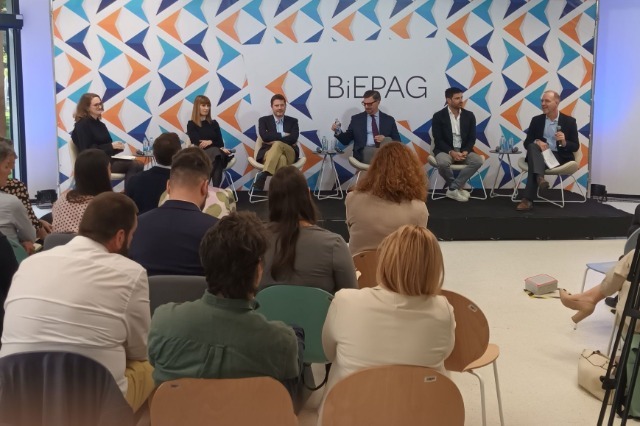
The European Union and the Western Balkans have squandered numerous opportunities over the past decade to advance enlargement policies, participants concluded at a panel in Sarajevo marking the tenth anniversary of the Balkans in Europe Policy Advisory Group (BiEPAG).
Founded as a joint initiative of the European Fund for the Balkans and the Centre for Southeast European Studies at the University of Graz, BiEPAG consists of 25 experts based in the six Western Balkan countries and the EU.
Aleksandra Tomanic, Executive Director of the European Fund for the Balkans, remarked that the region has seen few achievements worthy of celebration in the last decade.
“When BiEPAG was established, we hoped it would no longer be necessary after ten years. Unfortunately, most countries in the region remain in the early stages of EU membership. While we commemorate this anniversary, there’s little to celebrate when we consider the state of enlargement and democracy in the region,” Tomanic stated.
She highlighted that BiEPAG has served as a vital platform for experts advocating for the region’s EU integration over the past decade.
Florian Bieber, BiEPAG coordinator and professor at the University of Graz, emphasized that the enlargement process has failed to deliver the desired transformation in the region’s societies.
“This past decade has not seen significant progress towards enlargement. This is the longest period in EU history without any new member states,” Bieber noted. “Since Croatia’s accession 11 years ago, no new enlargement has occurred, and this trend is likely to continue. Meanwhile, we are witnessing notable democratic regression and the rise of ‘stabilocracies’ across the Western Balkans“.
Despite the shortcomings of the enlargement process, Bieber asserted that BiEPAG remains committed to its value.
“We are critical friends of enlargement. Our role as experts and analysts is to provide constructive advice, and we will continue to do so,” he added.
He then moderated a BiEPAG panel titled “European Union – Malo Morgen?”
Tena Prelec, a research collaborator at the University of Rijeka, pointed out that the EU often discusses an enlargement “moment,” yet fails to seize it effectively. She cited North Macedonia as an example, where significant changes by the authorities did not result in progress.
Prelec argued that the EU tends to view the region more as a semi-periphery than as part of the club.
Srdan Majstorovic, Chairman of the Board of the Centre for European Policy from Belgrade, highlighted that the war in Ukraine has created momentum for enlargement, but this momentum must translate into concrete actions.
“While there is a general understanding within the EU that enlargement is necessary, a lack of consensus among the 27 member states persists,” Majstorovic explained.
He stressed that the democratization of the region cannot be separated from European integration, asserting that democracy and the rule of law must remain central to the accession process. However, he noted that international indices indicate the region is regressing in these areas.
Lura Pollozhani, a researcher at the University of Graz, discussed young people’s attitudes toward the EU and enlargement, pointing out that fatigue has developed over the past decade.
“Many young people envision working in EU countries like Germany, representing a missed opportunity that went unnoticed. This process involves citizens, and their engagement is crucial,” Pollozhani said.
During the panel discussion, Marika Djolai noted that the EU had developed a tool for resolving bilateral disputes during the ‘big bang’ enlargement but failed to translate it into effective policies for the Western Balkans.
She highlighted that the EU has also missed symbolic opportunities over the past decade.
“A year after the Brussels Agreement between Kosova and Serbia, which showed progress for both countries, the EU halted the enlargement process,” Djolai recalled, also referencing the Sejdic-Finci case in Bosnia and Herzegovina.
“Symbolically, the EU sent a message to authoritarian and populist leaders in the region that such behavior is acceptable, ultimately leading to the enlargement process being dismissed by political elites,” Djolai concluded.
/a.p./
Të ngjashme

Latest News






Most read







 RTI
RTI