
 English
 Français
  Deutsch
 Italiano
 Turkish
 Greek
Greek Serbian
Civil Society Makes Significant Contribution to the Berlin Process




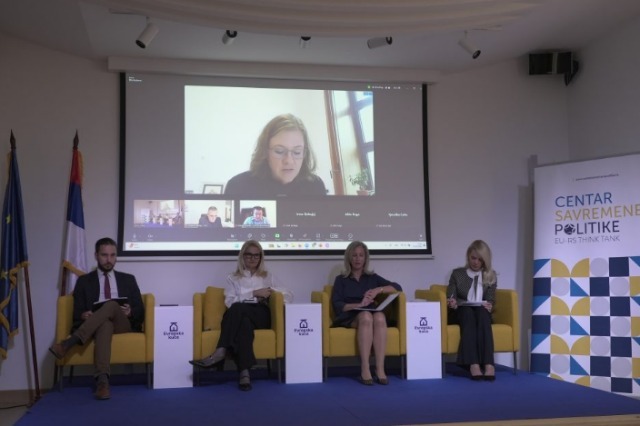
The creation of the Regional Common Market (RCM) is poised to bring significant economic benefits and expedite Western Balkan countries’ integration into the European Union. This conclusion was reached during a panel titled “Path to a Regional Common Market (RCM) and European Integration of the Western Balkans,” held at the House of Europe in Belgrade.
Organized by the Center for Contemporary Politics in Belgrade and the Institute for Cooperation and Development from Tirana, the RCM initiative aims to integrate the region as a step toward entering the EU’s single market. On October 14 in Berlin, the Prime Ministers of the Western Balkans signed the Declaration of Support for the Action Plan for the Regional Common Market covering the period from 2025 to 2028.
Ardian Hackaj, Research Director at the Institute for Cooperation and Development, highlighted the vital role of civil society in the Berlin Process over the past decade, emphasizing the need for greater involvement to influence decision-makers.
Nemanja Todorović Štiplija, Executive Director of the Center for Contemporary Politics, noted that the regional common market is a critical topic often overlooked in Serbian media. He emphasized its importance as preparation for the Western Balkans’ inclusion in the EU Single Market.
Valeska Esch, Senior Advisor to the German Federal Government’s Special Representative for the Western Balkans, pointed out that significant progress was made at the recent Leaders’ Summit of the Berlin Process, with agreements reached on issues such as higher education and investment reviews that will benefit citizens.
Tanja Miščević, Serbia’s Minister of European Integration, clarified that the regional common market is the “second pillar of the growth plan” and a prerequisite for accelerated integration into the EU. She also highlighted various initiatives facilitated by the Berlin Process, including joining the Single Euro Payments Area (SEPA) and aligning product standards with EU regulations.
Additionally, Dragana Gjurica, Secretary-General of the European Movement in Serbia, praised the recent Action Plan for the Regional Common Market as a serious document, noting that it addresses topics previously avoided by partners in the region.
The RCM is seen as a bridge between the Western Balkans and the EU, providing a foundation for increased cooperation and integration.
/k.s/
Të ngjashme

Latest News




Most read





 RTI
RTI