
 English
 Français
  Deutsch
 Italiano
 Turkish
 Greek
Greek Serbian
23 Years Since the Ohrid Agreement: Reflections and Future Directions




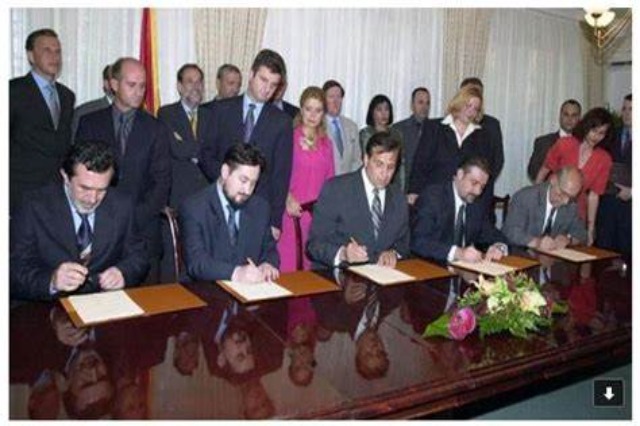
Ohrid Agreement, signed on August 13, 2001, has provided guarantees for language use, symbols, and decentralization for Albanians and other communities in North Macedonia. Former diplomat Nano Ruzhin highlights that, 23 years later, the question remains whether we have sufficiently cultivated the values of the Ohrid Agreement.
Ruzhin notes that the 2001 crisis underscored the need for greater democratic pluralism, ethnic democracy, decentralization, and multiculturalism. He poses whether pluralism is a dominant value of European ideals or merely an inherited concept. “Differences do not imply hostility,” he quotes philosopher Abelard, emphasizing the ongoing relevance of these principles.
Ohrid Agreement was signed by EU and US special representatives François Léotard and James Perdue, alongside local leaders. Since then, over 130 laws, amendments, and additions have been enacted, including 59 laws on non-discrimination and fair representation, and 40 laws related to identity, culture, education, and decentralization.
During a panel discussion, Deputy Prime Minister Izet Mexhiti described decentralization as a dynamic process that must adapt to citizens’ needs. He stressed the need for central authorities to provide local governments with more resources, independence, and development opportunities. Mexhiti called for a review of past solutions, noting that some current arrangements seem impractical and require legal and organizational redefinition.
Mexhiti emphasized that Ohrid Agreement was meant to serve the state, not a political party’s eternal participation in power. He stressed the need for modernization and Europeanization of the state, focusing on creating a society where institutions reflect full equality at all levels.
Prime Minister of North Macedonia, Hristijan Mickovski, reflected on the Ohrid Agreement’s anniversary, acknowledging that while no party was fully satisfied with the agreement, it brought peace to the country. He emphasized that shared patriotism involves building a future together, despite ethnic and religious differences.
Opposition leader Ali Ahmeti marked the 23rd anniversary separately from ruling parties, asserting that interethnic relations should be a cornerstone of security in North Macedonia. He stated that progress depends on good relations between the larger Albanian and Macedonian communities, stressing that harmony is essential for national advancement. /a.p./
/According to DW/
Të ngjashme

Latest News





Most read






 RTI
RTI