
 English
 Français
 Deutsch
 Italiano
 Turkish
 Greek
 Serbian
Albania is the season’s most exciting destination for families




Mrizi i Zanaze, an agriturismo–style farm restaurant in the north of Albania, is exactly the kind of place you long to find on holiday but somehow rarely do. There are gaggles of geese and excitable goats; there are pomegranate orchards and olive groves stretching into distant mountains; there is the most inviting little shop selling raki and preserves, and two wooden dining rooms that combine feelings of warm festivity with a serene efficiency.
Arriving after a two-hour drive, my family of four felt as if we had pitched up at a 19th-century country wedding. As the children (Teddy, ten, and Aubrey, three) fed the goats, my husband and Isipped fresh pomegranate juice and congratulated ourselves on our intrepidness. The place is nationally famous — Albanians and Kosovans apparently think nothing of an eight-hour round trip for lunch here — but on our visit we were the only western Europeans in sight.
When we asked to see the menu we were told that there wasn’t one. Instead, we were simply asked a few questions about dietary restrictions and appetite, and then settled in as dishes were paraded before us: leek pastries, pickled okra, stuffed courgette flowers, soft cheeses, hard cheeses, a hot cheese dip, cured meats, various pomegranate inventions, and a centrepiece of chicken roasted in a woodfired oven over an apple and raisin-studded pastry, gooey in the middle, crispy on the outside. Everything was a delightful surprise, including the bill: £37.26 for four. And OK, the children mostly had chips … but they were extremely good chips. If this place were in Tuscany or Catalonia, we agreed, it would be eight times the price and rammed full of influencers (mains from £5; mrizizanave.al).

We had come to Albania for a family holiday on the premise that the small Balkan nation might just be the “new Greece” or perhaps the “next Croatia” — a not-too-distant, reliably sunny, relatively inexpensive destination for a family beach holiday. It’s not an absurd idea. Greek salad is widely available, only they call it sallate fshati, village salad. The climate is indeed lovely (we went over Easter; I suspect it might get a little steamier in high summer). And Albania has a lot going for it in terms of location: just up from Corfu, across the water from Puglia, with Montenegro on the other side of its northern border.
Still, a few hours after landing in Tirana, the capital, it was clear that the premise had been totally wrong. You should come to Albania because it is the new Albania, a country with a unique history, culture and language, extremely friendly people and some of the best place names in the world. For example, should you wish to hike in the Alpine north you are advised to head to a town called Thethin a range known as the Accursed mountains — which are, as it turns out, extremely beautiful.Nevertheless, Albania’s geography has often seemed cursed.

The local population have struggled with invading Romans, Slavs, Visigoths, Ottomans and Fascist Italians. Postwar, the Stalinist dictator Enver Hoxha turned Albania into Europe’s own North Korea, imposing a form of communism so severe, he somehow alienated the USSR and China. The immediate post-communist years were marked by economic chaos and civil unrest. But there’s a palpable feeling of optimism in the air now, with Albania’s latest prime minister, Edi Rama, exemplifying the country’s new-found self-confidence.
A former basketball player and modern artist, fluent in five languages, Rama is open, cosmopolitan and urbane. While mayor of Tirana, one of his first acts was to have the city’s grey Stalinist façades repainted in bright colours.As an introduction to this tumultuous recent history, you could do a lot worse than read Free: Coming of Age at the End of History, a wonderful memoir about the 1990s by the Albanian-born philosopher, Lea Ypi. At least four people were reading it on our Ryanair flight, much like everyone reading Captain Corelli’s Mandolin on flights to Cephalonia. You can still see evidence of the rapid turns of recent Albanian history as you drive through the gently undulating hills: lots of half-built buildings, taxi drivers lamenting the state of the road, but also newly built mosques and villas and hoardings advertising luxury properties and hotel complexes.We were staying at the Melia Durres, a new five-star resort from the Spanish hotel chain, which is opening at least three more Melias in Albania. The complex is actually about 45 minutes’ drive from Durres (Albania’s second city and major port) and it is vast: 455 rooms, ten villas, six swimming pools and six restaurants. We were staying in a couple of interlinked rooms on a half-board basis, which includedbreakfast and dinner as well asaccess to an “exclusive” lounge area called the Level where our children were excited to discover they could get free drinks. My husband was less impressed that the selection of spirits disappeared on the second day, putting paid to his negroni ambitions.To enjoy a resort like this, you must make your peace with its rhythms.

Some of the communal areas felt a little shopping centre-like. The dinner buffets were an education in pan-European dining habits (“Octopuses! Thank you!” cried a huge Russian man, before piling his plate high with the things). We had one or two frustrations: there were no lifeguards at the beach; there was a football pitch but no balls to be seen. But, overall, the place was clean, tasteful and runwith efficiency and friendliness — the à la carte restaurants were mostly great. As was the spa, where the signature Turkish hammam treatment was incredibly soothing. My husband said he has rarely had a better massage.And it was hard not to relax when there was an epic 138m pool outside our sliding doors. Our three-year-old, however, had other ideas, gravitating to the warmer indoor pool and the playground.Nevertheless, the best part of the holiday was the second half, when we hired a car and made some day trips, away from generic hotel-land and into Albania proper. My husband is the driver in our family and seemed a little alarmed at the number of horse-drawn vehicles and the propensity of other drivers simply to stop in the middle of the road. Still, overall, “Less stressful than driving in London,” was his verdict. The city of Durres has a charming seafront, and feels a bit like a 1970s postcard. There’s a Roman amphitheatre that you can wander around (£2.50), many pleasant cafés and incredibly good ice cream (£1 a scoop) from Gelateria Cela.
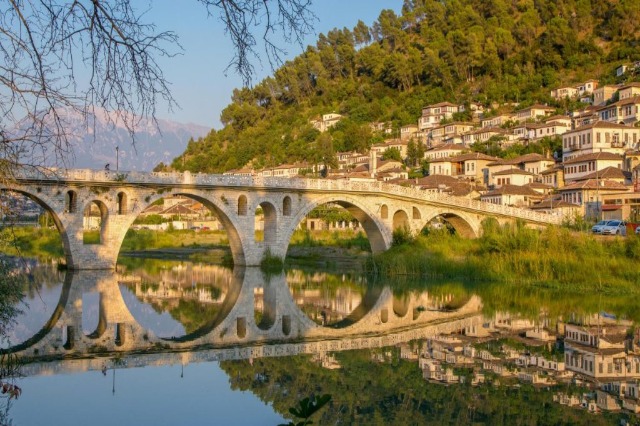
We also passed a tranquil afternoon exploring the steep alleyways of Berat, a Unesco world heritage site dating back to the Byzantine era. It’s known locally as the “city of a thousand windows” for its unique buildings that rise higgledy-piggledy up the hill next tothe River Osum to an acropolis. Edward Lear visited in 1848 and praised “a view that combines Tyrolese or Swiss grandeur with all the pretty etcetera of Turkish architecture”.

Another favourite excursion was to Shkoder, right up in the north near the Montenegrin border — and the gateway to the aforementioned Accursed mountains. It’s a sedate resort town with a pedestrianised centre that makes for a lovely walk with plenty of stops for extremely good coffee, as is the case everywhere we visited in Albania. Cheap, safe and laidback, it has a skyline dominated by the large Ebu Bekr Mosque, but it also contains plenty of beautiful low-rise buildings.
It’s not hard to see why it’s popular with backpackers.Family holidays can be exhausting. It isn’t easy to please everyone, particularly when you have children of different ages (in our case, a ten-year-old just on the cusp of enjoying more grown-up activities and the three-year-old very much isn’t). Our week managed to combine the easy pool break that satisfied the children with the element of intrigue and discovery that kept the adults entertained. Albania is relatively easy on the wallet too.
As is often the case, it was only having experienced the place that we worked out how we would do it again. We loved our excursions but it would probably be a better idea to arrange them end-to-end, to avoid all of those round trips. A nice itinerary might involve a couple of nights in Tirana itself; two or three days hiking in Shkoder and the Accursed mountains (don’t forget to stop at Mrizi i Zanaze on the way back); and then a few days of relaxing at a nice resort at the end, perhaps with a couple of day trips to nearby Berat and Kruje. It seems improbable that a country of such range and beauty that feels so intriguingly different is quite so near.
Të ngjashme




Latest News










Most read










 RTI