
 English
 Français
  Deutsch
 Italiano
 Turkish
 Greek
Greek Serbian
Deputy Director General of DG HOME, Luchner: Cyber security, key priority in the Western Balkans




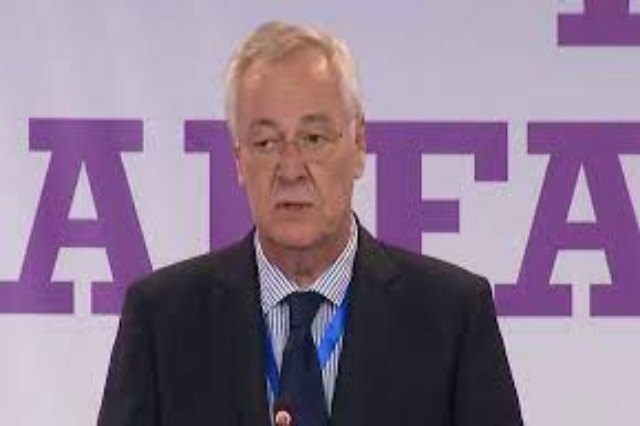
Johannes Luchner, Deputy Director General of DG HOME, European Commission, stated today at the start of the Ministerial of Interior Ministers being held in Tirana within the framework of the Berlin Process, that “cyber security has already become one of our key priorities in Western Balkans”.
Speaking about the integrated management of the border with the Western Balkans, Luchner said that, “for years we have intensively discussed the increased migratory pressures in the region and our joint efforts have brought results. The implementation of the EU action plan for the Western Balkans has reduced migratory pressures in this corridor”.
In general, he emphasized, “the migration pressure in the Western Balkans corridor has actually decreased by 25% in the first 7 months of 2023, with around 50 thousand irregular border crossings in this corridor, compared to the same period of the year 2022”.
Luchner underlined that the joint work has brought positive results.
Mainly, he added, “also with the alignment of your visa policy with that of the EU, with the approval of new agreements with FRONTEX, as well as with the arrival of additional FRONTEX officers in the region”.
“The Commission expects all Western Balkan partners to continue their efforts in terms of visa policy alignment throughout 2023,” said Luchner.
He emphasized that the EU Commissioner for Internal Affairs, Ylva Johansson expects the new agreements with FRONTEX to be signed quickly, as well as the quick implementation of the status agreement with Albania, which will be signed tomorrow.
Luchner also spoke about the fight against smuggling, as he emphasized that, “Commissioner Johansson has stated that the regional operational partnership against smuggling, which the Commissioner launched years ago in Tirana, in November, was followed by a technical meeting again in Tirana, with representatives of the member states, representatives of the countries of the Western Balkans and EU agencies, and the work continues with this partnership”.
Regarding regional cooperation in the fight against organized crime, Luchner congratulated Minister Balla for the work done in this direction.
“Soon”, he continued, “we will adopt the 2023 expansion package, which will of course also take into account the 2022 expansion package, also making a detailed assessment of the situation and the progress that has been made from the countries of the Western Balkans, as well as their journey towards the EU, focusing on fundamental reforms and work on priorities for reforms.”
“The fight against organized crime and the fight against corruption continue to remain important priorities and at the center of the EU’s political agenda. The Western Balkans partners are important allies in this matter and we ask that we continue to cooperate regarding these threats. We have shown our commitment in this field and with our actions to strengthen capacities”, he said.
“We have had fantastic joint operations that have taken place in recent years between the police of the member states and the police of the partner countries of the Western Balkans with the involvement of Europol. We have hit several organized criminal groups through this joint work, in particular those involved in international drug trafficking in fact, precisely the fight against drug trafficking should continue to be a priority area for us”, he said.
“Also”, continued Luchner, “we congratulate you and have welcomed the good cooperation with Europol. We already have more liaison officers than we’ve had from the region, who have been at Europol’s head office since the beginning of 2023, which is really valuable.”
He added that, “as far as the exchange of information is concerned, we must do more together”.
Speaking about cyber security, Luchner said that, “we all see that a threat to all of us is international cyber attacks, at a time when Russia is engaged in malicious cyber activities in the Western Balkans and we are their victims. That’s why we need to improve the monitoring of these actions to see what we can do better against these cyber attacks”.
“Cyber security has already become one of our key priorities in the Western Balkans and in fact we saw it in the political statement of the new growth plan for the Western Balkans that President Von der Leyen held in May 2023. Immediately after the cyber attacks, in the region, in the summer of 2022, the EU accelerated its support, strengthened it, by way of technical assistance and with a rapid response project, focusing on capacity building”,added Luchner.
He reiterated that, a strong cooperation of all partners in the region is needed.
“Regional cyber security program, financed with IPA funds, which started in March 2023, will continue to address the individual needs of each of the partners in the Western Balkans, with a special emphasis on regional cooperation and joint activities. The proposal brought by Minister Balla to develop and further create regional early warning mechanisms deals precisely with this clear need to strengthen risk management, to response mechanisms to incidents in the Western Balkans. And in fact, the re-creation of such a network for these incidents is very important and the EC will continue to play its role in this field”, Luchner was quoted as saying.
/k.s/
Të ngjashme

Latest News




 RTI
RTI