
 English
 Français
 Deutsch
 Italiano
 Turkish
 Greek
 Serbian
Biodiversity in Albania




Albania is a Mediterranean country on the Balkan Peninsula in the south of Europe. Albania sits at the interface between the mountainous Balkans, a continental European climate and the Mediterranean region. The Albanian coastline is 476 km long, and the Adriatic and Ionian
Seas have a great impact on the climate, flora, and fauna in the country. Part of the Balkan region, Albania is a relatively small country. Most of the country is mountainous, rising to 2700 m, and 41 % of the 3.3 million population lives on the extensive coastal plain. The population has doubled over the last thirty years and there is substantial migration towards the cities of the coastal zone.
Although Albania is a small country, it is very rich in biological and landscape diversity. This is due to its geographical position, geological factors, hydrology, climate, and soil conditions. Albania is part of the Mediterranean Alps in the line Dinarido-Albanido-Helenid, and is characterised by a diversity of rock formations since Palaeozoic time. There are more sedimentary and volcanic formations, while metamorphic ones are less common. Other formations such as alluvial, proluvial, koluvial, and deluvial glaciers, marshes, and lakes, are younger and from the Quaternary area. Within Albania there are tectonic zones which during their geological development changed to tectonic and neo-tectonic configurations.
The Albanian relief is mostly hilly and mountainous. There is a diversity of morphological formations and slopes. It has a young age since the Albanian relief originated during the Miocene Age. At the beginning of the Quaternary Age, the Adriatic lowland and other inland lowlands were attached to the continental part of Albania, but the existing relief shape was formulated during the Pliocene Period.
The evolution of the Albanian relief continues to this day. The highest point is 2751m above sea level (Korabi Mountain) and the lowest one is 8 meters below sea level (the former Terbufi Marsh). The medium altitude of the country is 708m above the sea level. The altitude declines moving from the east to the west of the country, and this determines the conditions of the climate, land, and vegetation. The climate of Albania is diverse. It has four major climatic zones and 13 sub-zones, which contribute to the country’s rich biological diversity. Albania is well known for its rich and complex hydrographic network composed of rivers, lakes, wetlands, groundwater, and seas. The main rivers are the Drini, Buna, Mati, Shkumbini,
Semani, Vjosa, Erzeni, Ishmi, Bistrica, and Pavllo, and their courses have an important effect on the country’s coastal biodiversity. About 247 natural lakes of different types and dimensions, and a considerable number of artificial lakes, are located inside the country.
Based on their origin, they are divided into tectonic lakes (4), glacier lakes (134), carstic lakes (94), and fluvial lakes (15). Among the more important ones are the transboundary lakes of Shkodra, Ohrid, and Prespa, the most important and largest ones in the Balkans with
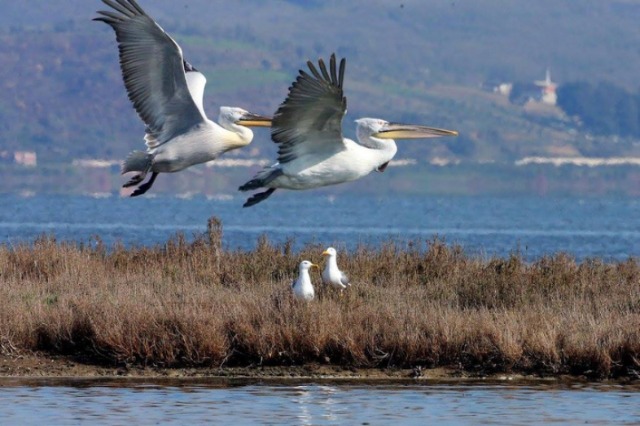
European and international significance. In the coastal area of Albania there are wetlands such as Karavasta, Narta, Patoku, Viluni, Kune-Vaini, Orikumi, and others, with a total area of 150km2
/k.s./
Të ngjashme




Latest News










Most read










 RTI