
 English
 Français
 Deutsch
 Italiano
 Turkish
 Greek
 Serbian
Agreement with Kosova and Croatia: Defense Minister Vengu: Defense Capacity-Building, Not Aggression




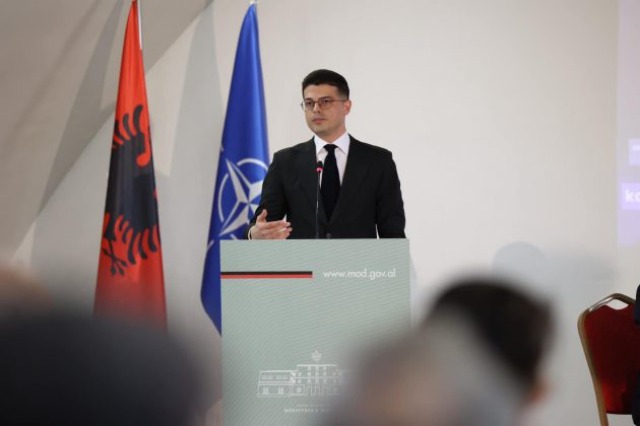
Defense Minister Pirro Vengu stated today that the recently signed defense agreement between Albania, Kosova, and Croatia is not an aggressive pact targeting any regional actor, but rather an alliance aimed at strengthening defense capacities.
In a televised interview, Vengu elaborated on the agreement signed yesterday and addressed reactions from Serbia.
“This agreement does not promote aggression against anyone in the region. I have seen media portray it as a threat to Serbia or others, but that is simply not true. We do not see ourselves as an alliance formed against anyone but rather as a partnership for security and defense cooperation, allowing the three countries to enhance their defense capabilities,” Vengu said.
The minister confirmed that the Ministry for Europe and Foreign Affairs had informed him of Serbia’s reaction to the agreement. However, he dismissed Serbia’s objections, stating that the country had forfeited its opportunity to be consulted due to its continued “empty chair” policy in regional meetings.
“For over two years, Serbia has boycotted all Adriatic Charter meetings, regional defense ministerial gatherings, and other key forums. It cannot demand consultation on matters it refuses to engage in. Albania and Croatia, both NATO members, share a common strategic vision for the region and do not need external consultation when forming a joint agreement with Kosova, which Croatia recognizes. If Serbia had wanted to be consulted, it should have participated in regional cooperation forums where Kosova, Croatia, and others have equal representation,” Vengu emphasized.
Vengu revealed that the agreement has been in the works for over a year and was finalized during the latest NATO ministerial meeting in Brussels. The agreement is based on three key pillars: military industry and procurement, military training and deployment, and supporting Kosova’s integration into Euro-Atlantic structures.
The three countries will collaborate to revitalize their military industries, conduct joint procurement, acquire shared defense equipment, and coordinate their armament strategies. The agreement also facilitates closer cooperation between the Armed Forces of the three countries, including joint training programs and coordinated troop deployments for shared missions. Albania and Croatia reaffirmed their unwavering support for Kosova’s integration into Euro-Atlantic structures, including key regional initiatives that advance its EU and NATO membership aspirations.
“A fundamental element of this agreement is our expectation that NATO will remain engaged in ensuring security in Kosova and across our region,” Vengu stated, calling the agreement a natural alliance.
Asked whether the agreement includes provisions for Albania and Croatia to deploy additional troops in Kosova in case of a Serbian threat, Vengu reiterated that “Kosova’s primary security guarantee is KFOR, NATO’s mission in Kosova”.
“Albania and Croatia have supported increasing KFOR troop numbers in Kosova, as well as expanding our contingents in the EU mission in Bosnia and Herzegovina. Kosova’s second layer of security relies on unblocking political dialogue with Serbia and securing full inclusion in all regional security platforms,” he added.
Vengu also confirmed that the agreement remains open to other countries.
“We have already received interest from our Bulgarian colleagues, who share our regional security perspective and recognize Kosova’s sovereignty. If other countries express interest, we welcome them. Montenegro and North Macedonia, for example, are free to join if they align with the principles of this agreement,” he concluded.
/a.p./
Të ngjashme
Latest News


Most read










 RTI