
 English
 Français
 Deutsch
 Italiano
 Turkish
 Greek
 Serbian
Safeguarding Albania’s Heritage: The Restoration of Myfit Bey’s Legacy




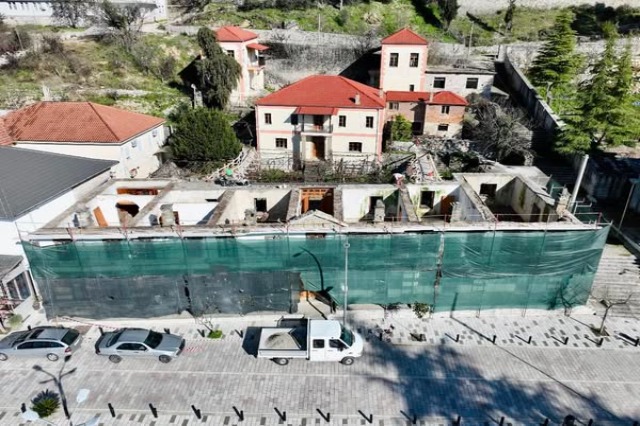
The National Institute of Cultural Heritage brings attention to the Saray of Myfit Bey in Libohovë as an outstanding example of cultural heritage restoration.
This project focuses on conservation interventions, particularly on the building’s roof, with the aim of safeguarding and preventing further deterioration of this valuable cultural asset.
Through these restoration efforts, the building is being reintegrated into the city as an enhanced tourist attraction. The Saray of Myfit Bey Libohova is located at the heart of Libohovë, on the left side of the main boulevard, directly across from Avni Rustemi Square. Recognized as a Category II Cultural Monument, it was built in the 1930s.
Myfit Bey Libohova, a distinguished diplomat of the Ottoman Empire and a key figure in the foundation of Albanian diplomacy, played a crucial role in the establishment of the country’s national bank and currency. His name is closely associated with numerous political activities leading up to World War II.
For Eqrem Bey Vlora, he was a man of great intellect and refinement, while Sejfi Vllamasi regarded him as merely another supporter of Italian influence in Albania. His legacy is still deeply felt in Libohovë, where locals respectfully preserve his grave, the plane trees he planted nearly a century ago, and, of course, his family’s historic saray.
The Saray of Myfit Bey holds additional historical significance, as it welcomed Shanishaja, the sister of Ali Pasha Tepelena. It was in her honor that the famous Castle of Libohovë was built, which still stands today with its monumental walls. Both Shanishaja and Myfit Bey are buried in the family türbe located in Libohovë.
/a.c/
Të ngjashme



Latest News










Most read










 RTI