
 English
 Français
 Deutsch
 Italiano
 Turkish
 Greek
 Serbian
Vithkuqi, a tourist village with historical and cultural values that never fade




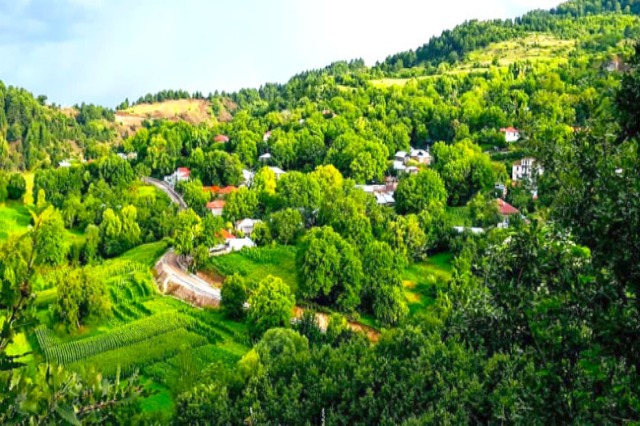
Vithkuqi is a tourist village with historical and cultural values that never fade, a treasure yet to be fully explored, not only for the medieval and Renaissance periods but also later, continuing the tradition with its residents’ vision, cultural horizon, and openness.
Vithkuqi is an ancient Illyrian settlement. Though little explored, it dates back to the early Iron Age until the 2nd century BCE. Evidence of this includes the castles placed to safeguard the region, such as Boshanjit, Bellovoda, Leshnja, as well as the mounds in the old neighborhoods of Vithkuq: Qyran and Qyrshas.
In historical documents, it is mentioned as a settlement in the Principality of Muzaka since the 15th century, but the most significant document indicates that Vithkuqi has been inhabited since the 12th century, as the first church in Vithkuq, that of Saint Athanasius, was built in 1162.
In the 17th-18th centuries, Vithkuqi was known as a developed town, reaching its peak with 24 neighborhoods and a population ranging from 12,000 to 15,000 residents. Besides the first church (St. Athanasius Church), there were 17 other churches, 3 monasteries, and a Metropolis center.

Meanwhile, a school, equivalent to that of Voskopoja, existed. In the years 1781-1819-1823, the town of Vithkuq suffered three major destructions, reducing it to a small village with only 13 families. Around 1856, Vithkuqi recovered and reemerged as a village with 150 houses and its three current neighborhoods. The population of Vithkuq migrated within and outside the country, forming many villages with an entirely Vithkuqi population (Mandrica in Bulgaria, Lehova in Greece, etc.).
Vithkuqi can also be identified as the village of churches and monasteries, as it once had more than 24 and currently has 14 such monuments. All unique, these cultural landmarks are scattered in the midst of the greenery, offering rare views.
Culture and tradition
The weight and significance of a place is not only measured by its natural beauties but more so by its people and the level of development, shaped by its history, culture, and traditions inherited over centuries. Vithkuq has had influential men, patriotic figures like Evstrat Vithkuqari, Kostë Cepi, Spiro Dine, who have honored not only their birthplace but the entire Albanian nation, along with many other notable figures. A prominent figure from Vithkuq is Naum Veqilharxhi, the first figure of the Albanian Renaissance. His encyclical letter is the preamble and the first document of the new political platform emerging among Albanian intellectuals.
Vithkuq residents are beloved, hospitable, with a rich cultural heritage, influenced both by their emigration in Europe and America. The distinctive clothing of both men and women has been notably beautiful. Vithkuq women are skilled at working with fine wool, used not only for clothing but also for making carpets, blankets, etc. Hospitality, generosity, and warmth are the atmosphere that Vithkuq creates for its guests.
Regarding music tradition, Vithkuq folk songs continue to be preserved today, unaffected by foreign influences. They are sung by young girls and boys during their family celebrations, accompanied by the dance known as “Dados,” which is the typical dance of this village.
Vithkuq is also known for organizing many traditional festivals, some with a more religious character, like the St. Peter’s Fair on June 29th and St. Nicodemus, which is also the celebration of the ” Vithkuqi Brotherhood” association on July 10th.

Situated among gentle hills, surrounded by dense beech and oak forests, 25 km away from the city of Korça, Vithkuq constantly evokes curiosity and mystery about its existence. A visit to this village can be considered truly enchanting, as its pristine beauty unfolds in every corner, offering a picturesque panorama.
In Vithkuq, you can choose to walk through winding paths and enjoy the extraordinary beauty of nature, a beauty closely linked to the cultural and historical heritage of the village. The diversity of historical and cultural landscapes gives Vithkuq its identity.
One of the key elements in the development of tourism in Vithkuq is its historical treasure. From antiquity to the late Middle Ages and up to the present day, there are numerous cultural monuments, events, and historical figures that go beyond the scale of a village or town.
One such attraction worth visiting is the Church of St. Michael, which houses frescoes in two layers, bearing the signatures of David Selenica and the Zografi brothers. Next to the ‘St. Michael’ church, among the village graves, a grave with a large cross that reads “Baptism Grave” raises curiosity.
Apart from the fresh climate, natural beauty, another attraction for tourists is the Cold Water Spring, which can be found in at least 100 springs and is often a refreshing stop to quench thirst. Tourists are also drawn to the characteristic stone-built houses, suitable for accommodation.
Unique and rich is also the culinary tradition of this village with pastërma(dried meat), trahana(made of flour), baked meat, pickles, corn and pies, milk pie etc. The cuisine in this area is an ancient tradition of the entire region, a blend of tradition, authenticity, and various cultural exchanges.

/k.s/
Të ngjashme




Latest News










Most read










 RTI