
 English
 Français
 Deutsch
 Italiano
 Turkish
 Greek
 Serbian
Tirana to Welcome European Political Community Summit on May 16, Gathering Leaders from Europe and Beyond




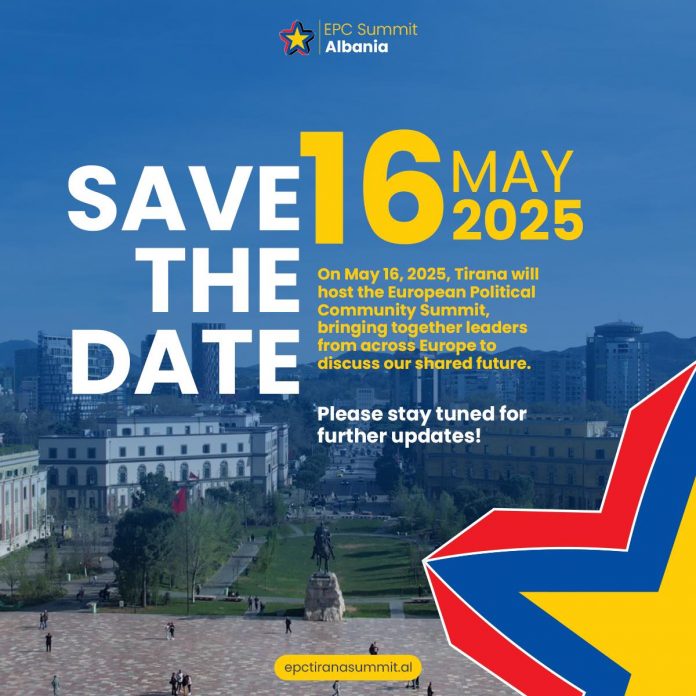
Tirana will host the European Political Community (EPC) Summit on May 16, bringing together heads of states and governments, as well as leaders of key European and international institutions.
The first-ever hosting of this summit in the Western Balkans not only symbolizes recognition of Southeast Europe’s role within the European political framework but also serves as a strategic investment in shaping the continent’s future.
The summit in Tirana comes at a critical time for Europe. A war continues on its eastern border, global tensions are rising, and hybrid threats, economic challenges, and technological disruptions are testing democratic resilience, demanding more coordinated European responses. In this context, the European Political Community emerges as a vital platform for unity—one that transcends institutional boundaries and unites all European nations to exchange ideas, address shared challenges, and chart a collective path forward.
Tirana summit will serve as a platform for open political dialogue and practical cooperation. The agenda will address the most pressing issues facing European citizens today, while also providing a forward-looking space to shape the future with clarity and ambition.
The summit will focus on four key topics to be discussed in high-level roundtables: Security and Democratic Stability; Strengthening Economic Competitiveness and Security; Migration, Mobility, and Youth Empowerment; and Vision, Leadership, and New Approaches for Europe in a Changing World.
The first roundtable will focus on Europe’s security and democratic stability, including support for Ukraine in its efforts for a just and lasting peace, as well as long-term challenges such as protecting democratic processes from foreign interference and strengthening Europe’s collective defense capabilities. The second roundtable will explore how to enhance economic competitiveness and security, with an emphasis on innovation, digital infrastructure, energy resilience, and the strategic autonomy needed to secure critical supply chains while balancing climate objectives with industrial power.
The third session will address the complex dynamics of migration, mobility, and youth empowerment. From the need for legal migration pathways and cooperation with countries of origin and transit, to the weaponization of migration and the challenge of retaining talent within national economies, leaders will explore coordinated, partnership-based solutions with foresight. The role of the next generation in shaping Europe’s future, particularly in the context of artificial intelligence and the rapid pace of technological change, will also be discussed.
Finally, the fourth roundtable will offer a forward-looking perspective on inclusivity, equality, and institutional agility, highlighting the need for Europe to act with greater decisiveness on the global stage.
Albania’s role as host reflects its deepening European aspirations and its contribution to regional and continental stability. As a NATO member, an EU candidate country, and an active participant in regional cooperation, Albania is uniquely positioned to organize such an important dialogue at a time when Europe must act with greater cohesion.
The European Political Community Summit will take place in the heart of Tirana, in Skanderbeg Square, a space where Albania’s history and modern identity come together. Surrounded by cultural and governmental institutions, the square represents the country’s democratic transformation and forward-looking spirit. Today, it stands not only as a symbol of national renewal but also as a fitting venue for open dialogue, shared aspirations, and a stronger, more united Europe.
Të ngjashme
Latest News










Most read










 RTI