
 English
 Français
 Deutsch
 Italiano
 Turkish
 Greek
 Serbian
Dardha village, a popular tourist destination




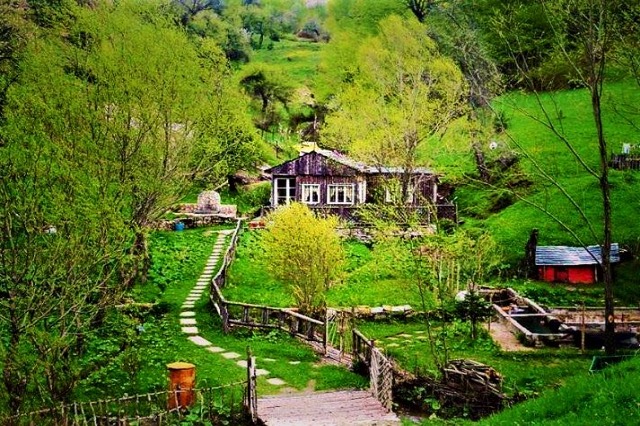
Dardha is a village in the district of Korça, 19 km from the city and 185 km from the capital, at an altitude of 1344 m. It is a village created in the depths of the Morava mountain 300 years ago by those who had fled from the Ottoman invaders because they had not accepted to change their religion.
The mountain village, with a very rugged and steep relief, with cobbled streets and many cuts, has become known for its very beautiful nature and for its healthy air and climate, for its traditions and for its outstanding people. At the beginning of the century XX, around 1913, Dardha had 400 houses, built of stone according to a special architectural model, which gave the village the appearance of a town.
Family tourism is the only economic activity in the village, since almost all the houses in the village are available to tourists. Also, there are modern hotels and various hotel and tourist resorts with high standards of service and accommodation. To some extent, mountain tourism and sports – winter tourism is also developed, as Dardha, with its ski slope, is an ideal place for skiing during the winter. As a mountain village, a one- or two-day picnic has become a tradition, mostly on weekends, with guests coming from Korça or the villages of the plain.

Dardha cuisine is known for its autochthonous specialities. Traditionally Dardha women have been involved in preparing a lakror, made of rolling the filo dough into thin layers, later opening the pastry and placing it in a tin, or pan. The filling is prepared separately by boiling minced vegetables. A variety of fillings can be made from different vegetables such as cabbage, spinach, squash, or those with a strong flavour like onions and leeks.Other fillings are made from meat such as beef, lamb or involve combining ingredients like tomato and onion, tomato and pepper, spinach with cheese or with eggs, milk and (olive) oil. They are also known for preserving food, pickles and pastrema(that is dried up meat). Roasted meat and pancakes are also a specialty.
In addition to the traditional cuisine, Dardha is also known for its rich cultural heritage, the special architecture of stone houses. The ethnographic and spiritual heritage is expressed through songs and dances, especially the “Dardhare dance”, as well as the characteristic Dardha traditional costumes.
All this culture has been displayed in the museum, through photographs and other exhibits showing the rich history of the village at different times. It should be noted that Dardha, in its history, had 12 photographers, such as: Jani Zengo,Pero Kaçauni,Thimi Raci,Theodhor Stefani, Leon Çika, Alqi Golloshi etc. Besides photographers, the village also had 24 iconographic painters, who worked in the XIXth century to the beginning of the XXth century.

Dardha has very attractive and varied landscapes in nature with considerable altitude. In addition to nature, there are crowns of colorful forests, there are narrow and cobbled alleys, there are stone houses with stone tile roofs, there are courtyards full of flowers, there are gates with artistic motifs, there are many fountains – beautifully built taps.
It is worth noting that once there were about 100 springs in Dardha, some of which still exist today. Dardha remains one of the most favorite places for tourists in Albania. It is an open-air museum that must be visited, but it is also ideal for relaxing. During these last two decades, the village has turned into an important tourist center, visited by many tourists, not only from Albania, but from many countries around the world.
/k.s/
Të ngjashme




Latest News










Most read










 RTI