
 English
 Français
 Deutsch
 Italiano
 Turkish
 Greek
 Serbian
Feasibility Study for Durrës–Prishtina Railway Presented in Shkodër; Deputy PM Balluku: Port Project Enters Decisive Phase





Feasibility study for the Durrës–Prishtina railway line was presented in Shkodër.
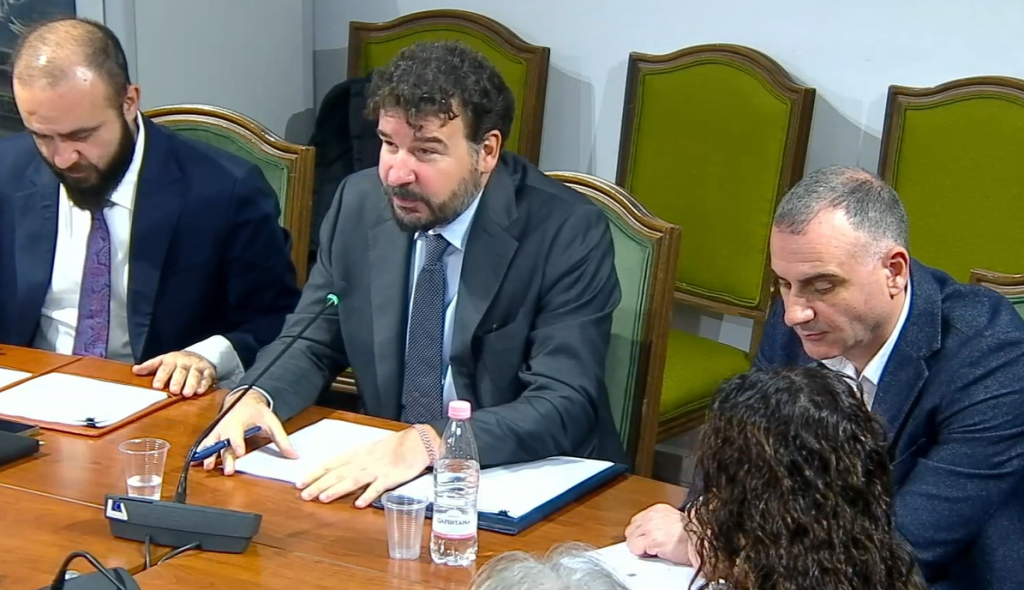
Minister of Infrastructure and Energy, also Deputy Prime Minister, Belinda Balluku, stated that the project for the new Port of Durrës has now entered a decisive phase. She noted that the first stage—comprising the submission and technical evaluation of bids, had been completed, and that the project was ready to move into the second phase, after which construction of the port would begin.
Balluku emphasized that the new port will be linked with two dry ports in Prishtina and Skopje via railway lines. According to her, one railway will start in Vora and pass through Shkodër toward Kosova, while the other will connect to the Rrogozhina–Pogradec axis and continue into North Macedonia.
She explained that the Port of Durrës has not been designed to serve only Albania, but also Kosova and North Macedonia. The dry ports of Prishtina and Skopje will be integrated into this network, one through the Vora–Shkodër–Prishtina line, and the other starting in Durrës. She added that the contract and funding agreement for the first segment of this line, up to Rrogozhina, has already been signed, and that the project will continue along the Rrogozhina–Pogradec corridor, eventually crossing the Bushtrica Bridge to North Macedonia.
Deputy PM Balluku said these developments are part of a broader vision to prepare Albania for integration into the European Union. She underlined that these are not just infrastructure upgrades but also political steps forward for Albanian-speaking regions, positioning Albania, and by extension, Kosova, for a new chapter beyond the transition period.
With EU accession talks ongoing and encouraging signals from EU commissioners, particularly from Commissioner Marta Kos, she noted that the negotiation process could be completed within the next two years. For this reason, both Albania and Kosova must be ready, including in key areas like energy and infrastructure.
While acknowledging that legal and administrative reforms are important, Balluku stressed that without meeting comparable infrastructure and energy standards, Albania would not be fully ready for Europe. She said that although project timelines are often set with built-in margins, projects in Albania are increasingly being delivered ahead of schedule.
She emphasized that there is no more time to lose, asserting that the Durrës–Prishtina railway will not take 10 years to complete. With decades already lost, 50 years followed by 33 years of transition, she said time is the only thing Albania lacks. Citing the Llogara Tunnel and the Vlora Airport, both completed well ahead of schedule, she expressed confidence that the railway would follow a similar path. She stressed the need to move quickly, while ensuring that all standards and procedures are respected.
Balluku concluded by saying Albania currently enjoys the full attention of the financial markets—both in terms of funding and foreign investors—and that by the end of the government’s fourth term, the Durrës–Prishtina railway project would show measurable progress, not just initial steps.
/a.p./
Të ngjashme


Latest News









Most read










 RTI