
 English
 Français
 Deutsch
 Italiano
 Turkish
 Greek
 Serbian
Finance Minister Malaj: Durrës–Prishtina Railway a Major Project; Funding to Proceed in Phases




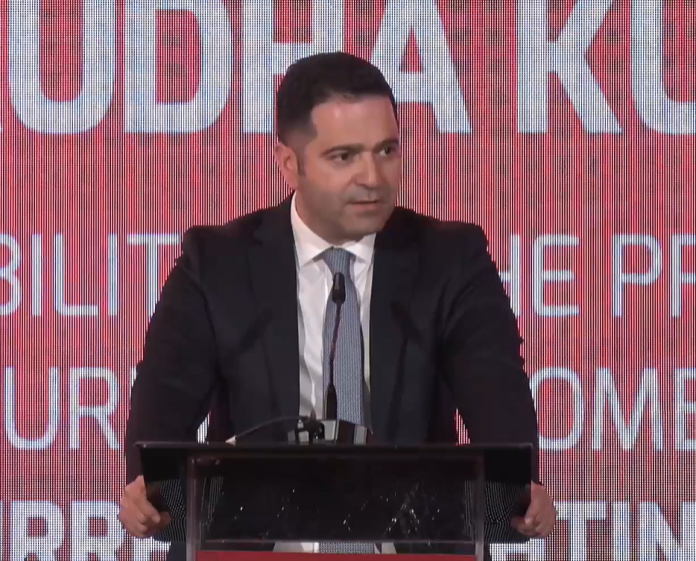
Minister of Finance Petrit Malaj described the Durrës–Prishtina railway as a bold step toward a future where mobility, trade, and cooperation overcome borders. Speaking from Shkodër, where the feasibility study and concept design for the railway were presented, Malaj said the project represents a transformative vision.
“This is a major project that will naturally come with a significant cost, as outlined in today’s presentation,” said Malaj. “Its financing will be carried out in several stages, requiring not only budgetary commitment from both countries but also support from international financial institutions”.
He noted that Albania’s increasingly favorable credit ratings from agencies such as Standard & Poor’s and Moody’s classify the country’s economy as highly stable. This, he added, will help ensure more affordable financing options for Albanian citizens and greater access to international funding.
Malaj said the completion of the feasibility study, jointly financed by the Albanian and Kosovan governments—marked the beginning of the right path forward.
“We continue to support projects with strategic connectivity importance,” he said, referring to the Durrës–Rrogozhina railway, part of Pan-European Transport Corridor VIII linking Albania to North Macedonia and Bulgaria, which recently received backing from the European Investment Bank. He also mentioned the rehabilitation of the Vora–Hani i Hotit railway, expected to be completed by 2030, which will shorten travel time to Montenegro.
For this reason, Malaj underlined that the Durrës–Prishtina railway should not be viewed merely as an infrastructure investment, but as an investment in development, connectivity, and the shared future of the region.
He emphasized several key aspects of the project:
“First, railway lines will significantly improve transport efficiency, both for freight and passengers. They will lower logistics costs, save time, and increase competitiveness for our manufacturing and export businesses. They will also provide faster and more affordable access to larger markets,” Malaj stated.
He added that the shift from road to rail transport will ease traffic congestion, reduce urban pollution and carbon emissions, and support the fulfillment of Sustainable Development Goals in line with Albania’s international commitments.
“This railway will also serve as a bridge between Pan-European Corridors VIII and X, offering the shortest and fastest connection between them,” he said. “That’s not just a geostrategic advantage, but an economic one, for both countries, as they aim to become key hubs for regional transport and trade”.
Malaj further noted that the project aligns with the European Union’s Connectivity Agenda and meets the highest standards of modern infrastructure.
“The most strategic benefit,” he said, “will be the transformation of the Port of Durrës into a regional logistics center, boosting freight transport from the entire Western Balkans to international markets”.
This, Malaj continued, would position Albania as a gateway for Kosovo and the region toward the Mediterranean and beyond, generating employment, investment, and sustainable economic growth.
“On the other hand, this investment will provide a new strategic momentum for the Prishtina Dry Port, which will become a key regional trade interconnection point,” he concluded.
Malaj reiterated that the Durrës–Prishtina railway is a bold step toward a future defined by increased mobility, trade, and cooperation—where borders become bridges, and new opportunities emerge for citizens across the nation.
/a.p./
Të ngjashme


Latest News









Most read










 RTI