
 English
 Français
 Deutsch
 Italiano
 Turkish
 Greek
 Serbian
Men’s traditional clothing in the North of Albania




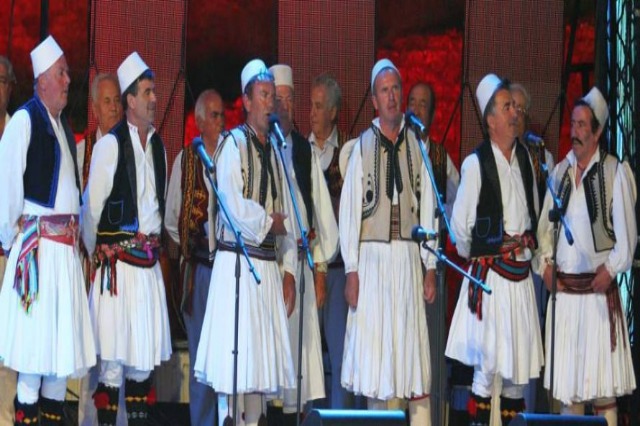
Cultural heritage includes tangible and intangible culture, as a set of cultural values bearing historical memory and national identity, as well as of scientific or cultural importance.
Clothing is one of the most important elements of folk art. Clothing is characterized by an artistic beauty and varies by region and gender. Folk clothes are compared to the Albanian language and other cultural traditions, they represent history in themselves.
Folk costume is a provincial symbolism, the clothes have been preserved and adapted until today from the South to the North. This clothing is a priceless treasure for the cultural tradition of our people.
Men traditional clothing in the North of Albania
Fustanella or Albanian kilt is men’s clothing getting its name from a type of waist wrinkle white skirt. Long underpants were worn under this skirt. In some cases these extended up to the thigh. In the upper part, a short shirt with wide sleeves, and a waistcoat were worn. Around the waist there is a wide woolen belt and over it, another one of decorated leather on which firearm & gear were hung. In the cold season, part of this clothing was also a fur coat. They usually wore a woolen fez. Until the beginning of the 20th century, fustanella has been worn in all Albanian territories, from Kosovo to Çameria. Then it was limited only to the villages of South Albania.
The most important parts of this men’s outfit are also the white shirt and the long woolen dollama or cibuni. In the summer season, instead of the dollama, a type of woolen vest and long pants were worn. Dollama or cibuni appears with several changes in different areas. In some places it was long above the knee, in other places it was up to the calves of the legs, some white and some black, decorated with black stripes. This clothing was used in Mirdita, Mat, Dibër, Highlands, Korça, Kolonja, Gjirokastra, etc. The dollama continued to be worn as a ceremonial garment or on assembly occasions.
The most typical element of this clothing are the tirqe, which are in the form of tight pants made of wool (in most cases white and rarely black). Generally, they are tied below the waist, accompanied by a woolen belt with discolored stripes. A long-sleeved shirt and sleeveless waistcoat , both made of wool, were worn over the top. In the cold season, a jacket with short sleeves and a collar (made of black wool) was also worn over the vest, called in some places xhurdi. Tirqe are usually worn in Northern Albania, Kosovo and North-Eastern Albania, reaching as far as the district of Berat.
Large woolen trousers are part of the folk traditional costume. They were always ankle-length and accompanied by a wide band of cherry-red fur. A shirt with long, narrow sleeves was worn on the upper part of the body. In the cold seasons, in addition to the woolen vest, the jakucja a type of jacket with many sleeves was also worn. This clothing was used in the villages of Zadrima (in warm seasons) in Central Albania and some villages of Mati, Martanesh, Mirdita, Librazhdi, Çermenika, etc.
Poture (wide leg pants) up to the knee have also been part of men’s folk costume. In the lower part of the legs (below the knee) woolen socks were worn. While in the upper part, a long-sleeved shirt was worn accompanied by a woolen vest, which was chest buckled. In the cold season, men also wore a a long sleeved jacket. This clothing had another part that distinguished it from other provinces, namely the woolen fez. This clothing was found mainly in Laberia, Mallakastër, Myzeqe, etc. Poture have replaced the frock skirt (fustanella) by the end of the 19th century.
/k.s/
Të ngjashme




Latest News










Most read










 RTI