
 English
 Français
 Deutsch
 Italiano
 Turkish
 Greek
 Serbian
Rumanian “Ziare”: Tirana, what can you do in the capital of Albania?




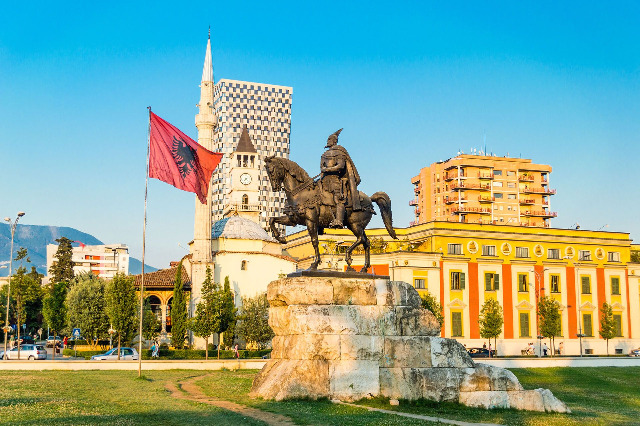
Once a sad and gray city, akin to many communist-era cities in Eastern Europe, Tirana has undergone a vibrant transformation. Today, it stands as a compact yet kaleidoscopic capital, breaking free from the rigid constraints that once bound it in the uniformity of red-tinted landscapes—a characteristic shared by many Balkan countries.
Tirana, known for its blend of bunkers, mosques, and remnants of Soviet architecture, offers an array of experiences for a weekend getaway in the capital of Albania.
Tirana not only stands as a remarkably safe city but also radiates a spirit of hospitality, embraced by its amiable and genuine locals. The evident surge in tourism in recent years reflects the concerted efforts of both the government and private sectors, investing substantially in its growth. Witnessing groups of visitors from diverse backgrounds—be it Asians like the Chinese or Japanese, as well as hearing languages such as German and French spoken on the streets—underscores the city’s increasingly international appeal.
Furthermore, encounters with Italian speakers are abundant, although this isn’t necessarily indicative, considering the strong ties many Albanians have with Italy. Almost every Albanian has at least one relative residing there, and if not, it’s highly likely that their spouse does.

While Tirana may not boast the grandeur of cities like London, Paris, or Barcelona, nor even the scale of Bucharest, it exudes its own distinct charm as a Balkan city. It is pleasantly organized, adorned with numerous restaurants and inviting terraces. A prominent feature is its expansive boulevard, reminiscent of the Moscow model, proudly showcasing dozens of red flags adorned with the emblematic black eagle. The city boasts a vast central square, complemented by mosques and churches that contribute to its rich cultural tapestry. Several parks and lake further enhance Tirana’s allure, offering serene retreats within the city.
A semblance with Brașov due to its proximity to the mountains

Tirana bears a resemblance to Brașov, situated amidst mountainous terrain. Notably, one of these mountains, Dajti, offers the option of ascending via cable car, providing a panoramic view stretching from the cityscape to the Adriatic Sea. While the summer months unveil its beauty, reaching altitudes of up to 800 meters via various trails, the current chilly weather doesn’t present an ideal time for forest hikes. However, during summer, the region showcases its allure with lush landscapes, making it an opportune time for outdoor adventures.
Beyond the central district, the cityscape of Tirana presents a diverse mix. There are sections marked by the somber presence of grey, weathered blocks, reminiscent of the Soviet-style architecture. Here, laundry hangs outside the apartments on wires, contributing to a particular visual ambiance.
In contrast, one can also find narrow, cobbled streets that echo the architectural patterns reminiscent of Turkish influence. Albania, during its centuries-long affiliation with the Ottoman Empire, was officially recognized as Arnavutluk, and its populace was referred to as ‘arnavutlars’ (Arnauts), a term that has been adapted over time.
Albania gained independence from the Ottoman Empire in 1912. Subsequently, in 1939, the country was occupied by the Italians, and in 1944, control shifted to the Communists. After enduring years of isolation under communist rule, Albania reclaimed its independence in 1991, transitioning into a democratic nation. Since January 2003, Albania has been acknowledged as a potential candidate for accession to the European Union, signifying its aspirations to join the EU.
Dictator Hoxha built 200,000 bunkers

Tirana, much like the rest of Albania, bears the scars of a tumultuous period during communism, a chapter it showcases with a certain, albeit paradoxical, sense of pride. The legacy of Enver Hoxha, akin to Ceaușescu in Romania, remains unparalleled globally. During his regime, Hoxha, who passed away in 1985, undertook the construction of over 200,000 bunkers across Albania—a staggering number that some estimations suggest could be as high as 700,000. Driven by a fear of nuclear conflict and potential invasions, he sought to provide a bunker for nearly every Albanian family. Consequently, these bunkers now dot the landscape ubiquitously, spanning cities, villages, fields, and forests.
Interestingly, the residence where Hoxha once lived, once a veritable fortress, has been transformed into a museum, offering visitors insights into the country’s past.
Under Enver Hoxha’s governance, marked by isolation from Europe and a professed commitment to Marxist-Leninist ideology, the Albanian government propagated an image of the nation’s transformation from a semi-feudal state to an industrialized one. To commemorate Hoxha’s legacy, the Communist Party of Albania constructed the Pyramid of Tirana—an exceptional and captivating structure erected in 1988. Initially designed as a museum in homage to the leader, the pyramid featured a golden statue of the dictator positioned atop its marble and concrete edifice. However, following the collapse of communism in 1991, the statue was removed.
Today, the pyramid has been repurposed into a cultural and artistic hub, symbolizing a shift from its original commemorative purpose to fostering creativity and cultural expression within Tirana.
Bunk’Art 1, situated in the city center, and Bunk’Art 2, located on the outskirts, stand as two of Hoxha’s bunkers, now transformed into intriguing tourist destinations. Admission fees are 7 euros for walk-ins, while online bookings offer a reduced rate of 3.5 euros. These sites offer a fascinating glimpse into the extent of the fixation that characterized the leadership of communist Albania. Remarkably, Hoxha went to the extent of creating nuclear decontamination chambers within these bunkers.
No McDonald’s or Starbucks, but the city offers excellent and reasonably priced dining options

Albanian cuisine is a treat for connoisseurs, offering generous portions at affordable prices. Locals proudly assert their expertise in preparing the most delectable lamb dishes. Among the noteworthy specialties are ‘byrek,’ a traditional pie filled with cheese or meat, ‘tave kosi,’ a delightful lamb dish cooked with yogurt, ‘sufllaqe,’ an Albanian take on shawarma, and ‘qofte,’ small Albanian meatballs. Enjoying a good-quality Albanian beer like Kojka or Peja, priced at around 1-2 euros, is a great option. However, wines tend to be pricier, primarily due to their Italian origin. In Tirana, hunger is not a concern, and bypassing fast-food establishments is recommended. Surprisingly, Albania does not have McDonald’s or Starbucks outlets, although KFC and Burger King are available. However, opting for restaurant dining over these chains is advised for a more authentic culinary experience.
Albania stands out as an affordable haven in an increasingly expensive world. The money one might spend over three days in Paris could feasibly cover expenses for a month in Tirana, including transportation, which remains remarkably inexpensive. For instance, a Wizz Air ticket from Bucharest, a mere one hour and 20 minutes flight, cost me 90 lei. With the airline offering four flights weekly and weekend options, accessibility is quite convenient. Accommodation, specifically at a centrally located hostel, amounted to 65 lei per night for a single room. Moreover, a satisfying meal could be enjoyed for approximately 22 lei. While there might be pricier venues, luxury five-star experiences geared towards mass tourism are not the norm here.
While in Tirana, I came across the most intriguing warning sign. It was for individuals with education or, heaven forbid, bladder issues. If you wish to avoid ending up on YouTube, it’s recommended to use designated restroom areas. Otherwise, there’s a good chance of going viral.
A Muslim-majority country that harmoniously coexists with other religions
The national hero is Skanderbeg, also known as Iron Arm, renowned for leading the Albanian liberation revolts in the 15th century against the Ottomans. The central square of Tirana, one of the largest in Europe, proudly bears his name and features his statue. Nearby, I observed two or three stray dogs, while a short distance away, three local troubadours had formed a mini band, playing the accordion. Along the square, historic landmarks such as the National Museum, National Theater, and Et’hem Bey Mosque stand as a testament to the rich heritage of the region.

In close proximity to the square lies the city’s most vibrant street. In 2007, George W. Bush made history as the first American leader to visit Albania. In commemoration of this event, a main street was named in his honor.
The population of Albania, including Tirana, is predominantly Muslim, a legacy from centuries of Ottoman rule. Additionally, there are sizable communities of Albanian Orthodox (20%) and Roman Catholics (10%). From 1967, the People’s Socialist Republic of Albania stood as the sole officially atheist state globally. During this period, churches and mosques were closed, and individuals with religious names were compelled to change them. At that time, Albania resembled North Korea today. However, the landscape has significantly changed. “My religion is Albania, and the Albanians are my brothers” is the motto that has fostered religious tolerance among these groups. It’s rare to spot hijabs or covered heads on the streets.
From the airport runway, the mountains come into view

Tirana Airport offers a spectacular view with the mountains visible behind the runways. However, its efficiency is somewhat lacking as it doesn’t accept mobile boarding passes; they must be printed either from the airline or at the luggage counter.
The local currency in Albania is the Albanian lek. Roughly, one euro equates to about 100 leke. The term “lek” is an abbreviation for Alexander the Great, the former renowned king of Macedonia, as referred to by Albanians. A bus service operates from the airport to the city, running every hour, 24/7. The fare is 400 leke, and the journey typically takes between 30 to 40 minutes, contingent on traffic conditions. Albanian drivers might not adhere strictly to traffic regulations, so exercise caution, especially at pedestrian crossings. This behavior can be understood to some extent due to historical reasons—during the communist era, ordinary Albanians were not allowed to own cars. There were only about 1,000 cars in the entire country, most of which belonged to the ruling party. Consequently, private driving was permitted in Albania only about 30 years ago. While there isn’t a subway, tram, or trolley system, many buses are hybrid. Taxis are also widely used, but most tourist destinations are conveniently connected within the city center, eliminating the necessity for public transportation to explore them.
The place from which Mother Teresa departed

Mother Teresa is a prominent figure in Albania. Born on August 26, 1910, in Üsküb (now Skopje), under the name Agnesë Gonxhe Bojaxhiu, she established the Missionaries of Charity order in Calcutta, India, in 1950. For over 45 years, she dedicated herself to caring for the poor, the sick, orphans, and the dying, overseeing the expansion of the Missionaries of Charity, initially in India and later in other nations. In 1979, she was honored with the Nobel Peace Prize. Beatified by the Catholic Church on October 19, 2003, she was canonized on September 4, 2016, in St. Peter’s Square in Rome. Mother Teresa’s presence is ubiquitous on various Albanian souvenirs, including mugs, magnets, towels, hats, and more.
Another prominent figure is Ahmet Zogu, also known as Zogu I, who held various significant positions in Albania during the first half of the 20th century, serving as prime minister, president, and eventually becoming king. He had a life story akin to an action movie; surviving an astonishing 55 assassination attempts across a ten-year period. However, Zogu eventually passed away peacefully while in exile in Paris.
Music and entertainment enthusiasts

Albanians take immense pride in their music and entertainment culture, celebrating the local origins of renowned artists like Rita Ora and Dua Lipa. In Tirana, there’s a vibrant nightlife scene with numerous clubs, complemented by a few malls. The city boasts a sizable shopping center located in the heart of town, offering an array of shops, including some high-end boutiques. Despite slightly lower average salaries, shopping enthusiasm remains robust, with prices on par with what one might expect. However, many residents receive support from relatives living abroad, maintaining a strong network of assistance. It’s estimated that the Albanian diaspora outnumbers the population within Albania itself, with a significant portion residing in countries such as Italy, Greece, Turkey, Canada, Australia, and the USA. Albania has a population of 2.8 million, and approximately 500,000 of them reside in Tirana.
The Albanian language exhibits some similarities to Romanian

The Albanian language shares numerous words with Romanian and possesses a somewhat similar accent. There are instances where you might feel you understand what’s being said, but upon closer listening, you realize that don’t understand anything. I recall an incident at the airport security where a lady greeted travelers with “Come on, come on,” which, although in Albanian, sounded similar to Romanian, conveying the same meaning. Interestingly, Albania’s national anthem, titled “The Anthem of the Flag,” features lyrics written by the Aromanian poet Aleksandër Stavre Drenova. The music, “Union is written on our flag,” was composed by Ciprian Porumbescu.
The must-visit list in Tirana should include the National Museum of History and the National Art Gallery. These places serve as gateways to the rich cultural heritage of this small yet historically significant country. Additionally, the Tirana Castle, constructed on the grounds of an ancient fortification, boasts a fascinating history and provides captivating vistas of the cityscape and the surrounding mountains.
Being south of Romania, Tirana enjoys a comparatively milder climate, particularly during the cold season. Winters are not excessively cold, with rainfall being more common than snowfall. Situated on the same latitude as Naples, Madrid, and Istanbul, and sharing the same longitude as Budapest and Krakow, Tirana experiences a climate that reflects this geographical positioning.

/m.ll/
Të ngjashme




Latest News










Most read










 RTI