
 English
 Français
 Deutsch
 Italiano
 Turkish
 Greek
 Serbian
The Washington Post: Preliminary Results Show Socialist Party Leading in Albania’s Parliamentary Election




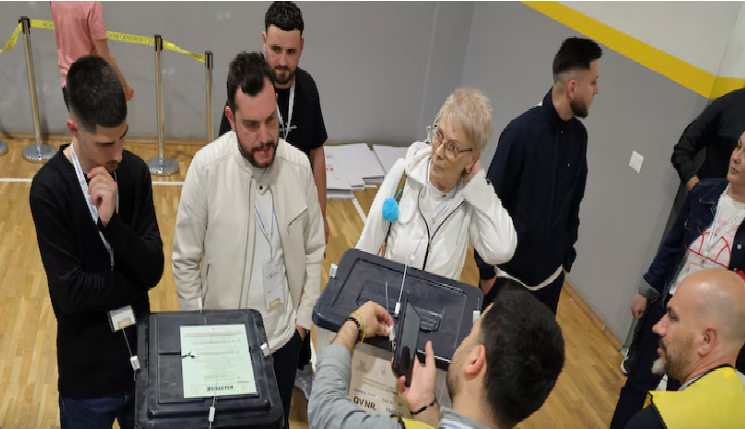
Preliminary results from Albania’s parliamentary elections on Monday indicate a lead for the ruling Socialist Party, with voters backing the country’s efforts to join the European Union and Prime Minister Edi Rama’s push for a fourth term.
With more than half of the votes counted, Rama’s left-wing Socialist Party had secured 53% of the vote. The opposition, a center-right coalition led by former Prime Minister Sali Berisha’s Democratic Party, followed with 34%. Three smaller parties are expected to win a few seats.
With these figures, the Socialists appear set to secure the 71-seat majority required to govern alone, and possibly more than they held in the last mandate.
Turnout on Sunday was 42.16%, around 4% lower than in the previous election four years ago.
Eligible voters, both in Albania and abroad, voted to elect 140 members of parliament for a four-year term. Due to mass emigration, Albania, with a population of 2.8 million, has nearly 3.7 million registered voters. For the first time, members of the diaspora were allowed to vote by mail, with around 191,000 sending in their ballots.
Ilirjan Celibashi, head of the Central Election Commission, said the election was largely peaceful, with some irregularities involving candidates and their supporters that would not affect the results.
“For the most part, excluding some sporadic cases, the process has been in line with the rules and standards,” Celibashi said on Sunday evening after polls closed.
Still, a joint observation mission from the OSCE’s Office for Democratic Institutions and Human Rights, the OSCE Parliamentary Assembly, the Council of Europe Parliamentary Assembly (PACE), and the European Parliament emphasized the need for comprehensive electoral reform in Albania. They noted that democratic reform and European integration are closely linked.
Despite being competitive and professionally managed, the election process was marked by the misuse of public resources by the ruling party, polarizing rhetoric from the main parties, lack of transparency in financing, and limited media coverage for smaller parties, the observers said.
Of the roughly 570 international observers in the country, 365 were from these institutions, underlining the international community’s interest in credible and transparent elections in Albania.
“The high interest displayed by Members of Parliament from so many countries in these elections is a manifestation of how much we care for Albania, for its people and for its future,” said Farah Karimi, the special coordinator of the observation mission.
Rama’s Socialist Party has pledged to deliver EU membership within five years—completing negotiations by 2027 and securing approval from all 27 EU member states by 2030. It’s an ambitious goal, particularly amid a contentious campaign against conservative opponents.
Rama, 60, who oversaw the start of EU membership talks in October, focused his campaign on achievements in infrastructure and justice reform. The Socialists have also promised to expand tourism, aiming to increase foreign visitors from 10 million in 2024 to 30 million by 2030, through major infrastructure projects. Rama also pledged to raise pensions and salaries.
His main challenger, Sali Berisha, 80, a former president and prime minister, argued that Albania is still not ready to join the EU. Berisha’s campaign resembled that of former U.S. President Donald Trump, including the hiring of one of Trump’s top campaign consultants.
-https://www.washingtonpost.com/world/2025/05/12/albania-parliament-election-socialists-european-union/a5598b32-2ef5-11f0-8498-1f8214bba2d2_story.html-
Të ngjashme

Latest News










Most read










 RTI