
 English
 Français
 Deutsch
 Italiano
 Turkish
 Greek
 Serbian
“La Gazzetta dell’Emilia”: Evidences of submerged bridges and mosaic floors discovered at the archaeological site of Butrint




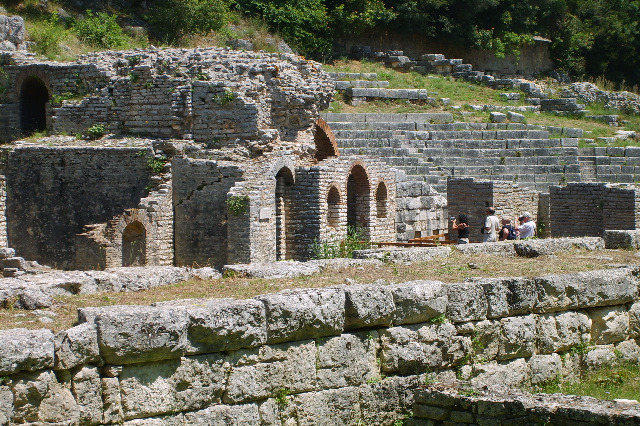
This year’s excavation campaigns revealed a remarkably well-preserved structure displaying signs of extensive and layered usage. These excavations also facilitated the documentation, for the first time through photographs and topographical surveys, of the pillars of a Roman-era bridge that connected the promontory, housing the ancient inhabited center, with the Vrina plain.
The submerged remnants of an ancient Roman bridge and a partially collapsed structure featuring mosaic-tiled floors, also from the Roman era but utilized extensively through late ancient and medieval times, continue to captivate at the archaeological site of Butrint in Albania, showcasing its ongoing array of surprises.
Spearheaded by the University of Bologna in collaboration with the Department of History, Culture, and Civilization, alongside support from the Ministry of Foreign Affairs and International Cooperation, and in partnership with the Institute of Archaeology of Tirana and the Butrint National Park, this excavation and research initiative was established in 2015. Since its inception, it has undertaken a series of missions dedicated to rediscovering the abundant historical relics of this affluent city in ancient Epirus.
Starting in 2019, the research group, under the leadership of Professor Enrico Giorgi from the University of Bologna and Professor Belisa Muka from the Institute of Archaeology of Tirana, has focused on stratigraphic excavation of the acropolis. Through successive excavation campaigns, diverse evidence emerged, showcasing the site’s enduring habitation from the end of the Bronze Age to the 18th century, illustrating its nearly uninterrupted occupation throughout history.
While the research in 2021 focused on documenting the initial phase of site structuring during the Archaic Age, likely centered around a sacred area enclosed by imposing polygonal walls, the two excavation campaigns conducted this year in June and September revealed evidence of subsequent and equally significant developments.
Professor Giorgi explains, “Last year, utilizing non-invasive methodologies, notably Ground Penetrating Radar for geophysical investigations, we detected certain ‘anomalies’ in the subsoil, suggesting the existence of potential buried structures.” He continues, “In this year’s campaign, we consequently opted to verify the nature of one of these anomalies through excavation.”
The investigation yielded unexpected results: the anomaly revealed itself as the perimeter wall of a building, remarkably well-preserved in its lower section due to the collapse of its roof, signifying its definitive abandonment. Upon clearing the debris, ancient cocciopesto floors adorned with Roman-era mosaic tiles were uncovered, accompanied by various artifacts dating back to late antiquity and the medieval period. These findings collectively suggest a prolonged and layered history of use for the structure.
However, surprises weren’t confined to the underground discoveries. Collaborative underwater reconnaissance in the lagoon surrounding the archaeological site, in partnership with Professor Stefano Medas from the Department of Cultural Heritage at Alma Mater (Ravenna Campus) and the Idra company of Venice, unveiled the identification of Roman-era bridge pillars.
Enrico Giorgi remarks, “The bridge served as a vital link between the Butrint promontory and the Vrina plain, facilitating the passage of the aqueduct supplying the core of the Roman city.” He adds, “This marks a significant milestone in the research of this ancient Epirus center, as it represents the inaugural documentation of submerged bridge remains through photographs and topographical surveys.”
Moreover, this year’s campaigns successfully concluded the topographic survey utilizing laser scanning to map the Hellenistic-era wall circuit within the city. This essential endeavor, aimed at assessing the current state of conservation of monuments in the archaeological park, marked the inception of the broader collaborative project between the University of Bologna and the Institute of Archaeology of Tirana at the Butrint site back in 2015. The forthcoming phase involving data processing will furnish the Park with a valuable tool, enabling effective planning for future conservation activities.
/m.ll/
Të ngjashme




Latest News










Most read










 RTI